Event 1
1857 Siege of Delhi
The [1857 Siege of Delhi](entity:event-recall-event-1857-7699f864cce0) is recalled as a defining episode in [Patrick Sumner](entity:character-recall-character-patrick-sumner-a3f07694d051)’s past: an assault he witnessed near Cashmere Gate and a sustained test of his work as a surgeon. The novel presents the siege through scenes of bombardment, overwhelmed medical care, and Sumner’s efforts to treat the wounded while danger advances through the city.
## Background and Narrative Frame
Sumner identifies the assault near Cashmere Gate as the setting for his experience on the first day of the attack. The episode returns later as a memory while he is feverish aboard a ship bound north and west; under the influence of opium, his thoughts drift back to Delhi. The framing makes the siege a remembered ordeal rather than a continuous account of the campaign, and locates its importance in the experience that Sumner carries away from it.
## The Field Hospital
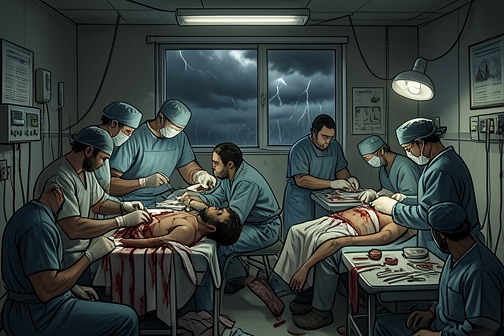
In Sumner’s recollection, casualties arrive at the hospital in a relentless stream. He works through the morning alongside the assistant surgeons Wilkie and O’Dowd, probing wounds, sawing, and suturing as one operation gives way to the next. The injured include men he had seen laughing and boasting only hours earlier. The volume of suffering leaves little room for anything beyond continuing the work.
The hospital’s staff must make decisions under pressure. [Corbyn](entity:character-recall-character-corbyn-f05b6d786e74), the staff surgeon, determines which limbs require immediate amputation and which might be saved. Price, an orderly, sorts those brought in, separating the dead from the wounded and directing the living into the treatment queue. Their distinct duties show a medical operation stretched to its limits: triage and surgical judgment are necessary simply to keep the work moving.
## Bombardment and Local Decisions
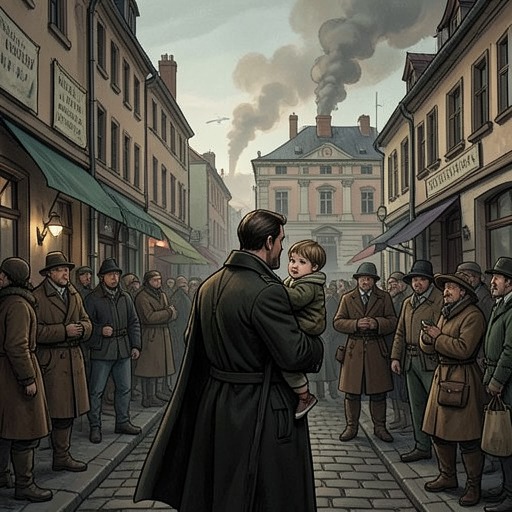
A separate scene in Delhi shows the attack pressing closer as British troops advance street by street. After the bombardment resumes at first light, the explosions grow louder, the room shakes, and damage appears in its ceiling. Sumner and a wounded boy shelter inside, with Sumner urging them to wait rather than expose themselves to the fighting. As gunfire and movement outside draw nearer, he nevertheless rises and approaches the doorway with the boy.
The danger exists alongside a competing pursuit. Corbyn stays with the boy while directing three men and Price to accompany a man seeking treasure; he tells them to arm themselves and return if the situation looks unsafe. He proposes shares for the group and a payment for Price, while suggesting that the prize agents need not learn of the proceeds. The juxtaposition places medical responsibility and the prospect of private gain within the same besieged setting: Corbyn remains with the vulnerable boy, even as he organizes a concealed expedition.
## Significance in Sumner’s Story
The siege establishes the conditions under which Sumner’s professional identity was formed. His recollection emphasizes not a single decisive battlefield encounter but the repeated demand to act amid casualties, uncertainty, and inadequate respite. The later scene of bombardment brings that military danger down to the scale of a room, a wounded child, and a decision about whether to stay sheltered or move. Together, the memories make Delhi a lasting reference point for Sumner’s experience of medical duty under violence.
Event 2
Sumner's Delhi treasure hunt and ambush
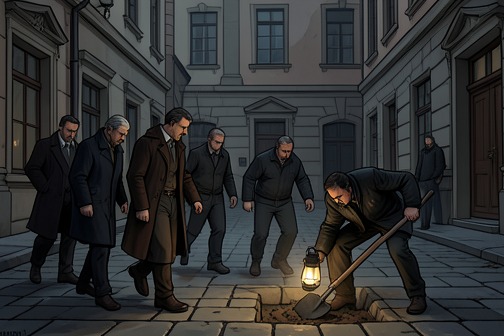
[Sumner's Delhi treasure hunt and ambush](entity:event-recall-event-2d45eb0c7f46) begins with a promise of wealth amid the work of a field hospital. The expedition turns that promise into a trap: Sumner and his companions are attacked in a courtyard, and he must survive alone in a city where the fighting has left civilians and soldiers at risk alike.
## The Offer and Expedition
A man seeking medical help offers to show Sumner and the other surgeons a buried fortune of gold and jewels, claiming it is worth two lakhs. [Corbyn](entity:character-recall-character-corbyn-f05b6d786e74) agrees to send three men with the stranger and to include Price, the orderly, while he remains at the hospital with the wounded boy. His terms make the venture more than an act of charity: the group is promised equal shares, with an additional tithe for Price, and the prize agents are to be kept from learning about the arrangement. Price leads them through narrow lanes and a largely deserted part of the city, past damaged buildings and signs of recent violence. At the destination, they find [Hamid](entity:character-recall-character-hamid-1ce111aa1530) digging beneath a flagstone in a small courtyard. The promise of treasure has drawn the party away from the hospital and into an enclosed space, where the group’s private bargain and the apparent urgency of the search leave them exposed.
## The Ambush and Flight
Hamid’s appeal for haste gives way to a silent gesture with two meanings: he raises his arms, and [Patrick Sumner](entity:character-recall-character-patrick-sumner-a3f07694d051) understands it as both refusal and surrender. A musket fires from the balcony. Price is killed, Wilkie is shot, and O’Dowd is attacked by a sepoy who has rushed into the courtyard. Sumner fires at the attacker, then makes for the street as shots continue around him; a bullet wounds his calf. The promise of a share in hidden treasure has brought the surgeons and orderly into an ambush, and the group’s hospital work is abruptly replaced by a struggle to escape the city’s violence.
Sumner leaves the street for a maze of alleys and takes shelter in a nearby house, where he finds a frightened boy lying in a dark room. He lowers himself to the floor and indicates his wounded leg, then discovers that he still has his gold ring from Delhi. Showing it to the boy, he gestures for him to take it, offering the valuable keepsake in the hope of obtaining help. The encounter shifts the immediate stakes from the failed search for treasure to a fragile attempt at mutual aid, while Sumner remains injured and cut off from his companions.
## The Failed Escape and Return
Sumner and the boy make their way toward the gunfire, hoping to reach the British troops, but the battle is already moving on. In the thoroughfare they encounter a British soldier carrying a pistol and a sack of loot. He notices the boy, hesitates, then shoots him. Sumner tries to help, but the boy dies; the soldier reloads and tells Sumner that he has saved his life. The encounter overturns any expectation that reaching British soldiers will mean safety: the boy who had offered help is killed by one of the men Sumner hoped would rescue them, while the soldier presents his own violence as a debt Sumner should remember.
A dooly arrives and carries Sumner through the damaged city to the field hospital behind the racquet court. The wounded surgeon is not recognized at first among the many casualties, but Corbyn sees him and has him moved upstairs into a room by himself. Sumner receives food, water, laudanum, and care for his injured leg. The hospital’s familiar sounds of cannon fire and wounded men continue below; when Corbyn later comes to see him, he asks whether the others are dead. The treasure expedition has ended not in discovery or profit, but in the loss of its companions and Sumner’s return to the same overwhelmed medical station from which the search began.
## Recollection and the Limits of Duty
The episode returns as a memory while Sumner is feverish aboard the whaling ship, moving north and west through fog, drizzle, and ice. His opiated thoughts drift away from the voyage and back to Delhi, where the field hospital had confronted him with more wounded men than its staff could treat. This shift in time makes the treasure hunt part of a larger recollection of the siege: the expedition is recalled not as an isolated adventure, but as a rupture in the work Sumner had believed he could continue by attending to one patient after another.
Before the expedition, Sumner and the other assistant surgeons worked through an unbroken sequence of cases. Corbyn, the staff surgeon, decided which injuries required immediate amputation; Wilkie and O’Dowd worked alongside Sumner, while the orderly Price helped manage the arriving casualties. Sumner’s resolve was to keep working because duty was the only available response. The expedition’s ambush reverses that arrangement: the surgeon becomes a wounded man, his companions are lost, and the capacity to help depends on escaping the fighting and reaching care himself. His return to the hospital restores him to its protection, but not to the earlier position from which he had set out.
The recollection also places Corbyn’s authority against the scale of the violence he has witnessed. His experience at Inkerman gives him a frame of comparison for the siege, yet the hospital’s continual demands leave little room for reflection; Sumner, too, has no time for anger or fear while the work continues. Remembered aboard a ship far from Delhi, the episode gathers those pressures into a single turning point: a covert promise of wealth leads away from medical duty, and the attempt to return to safety exposes both the vulnerability of the wounded and the limits of protection offered by military allegiance.
Event 3
Sumner's court-martial and discharge
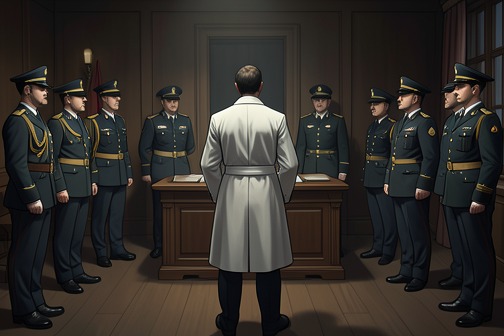
Sumner’s court-martial and discharge turn a disastrous episode during the siege of Delhi into the formal end of his military career. The proceedings are shaped not only by his departure from the hospital and the deaths that occurred during his absence, but by [Corbyn](entity:character-recall-character-corbyn-f05b6d786e74)’s refusal to explain the circumstances that preceded it. Later, the discovery of Sumner’s discharge papers aboard the [Volunteer](entity:object-recall-object-volunteer-3c8c66647ff2) confirms the result: he was court-martialed and left the army without a pension.
## Background in Delhi
During the siege, Sumner works as an assistant surgeon in a military hospital overwhelmed by casualties. The remembered scene is one of relentless labor: wounded men arrive in numbers, surgeons operate continuously, and Sumner tells himself that duty requires him to keep working. The hospital’s conditions and the demands placed on its staff establish the stakes of leaving a medical post during an assault. His absence will be judged against a setting in which injured soldiers urgently need treatment.
The treasure expedition begins within that same crisis. Corbyn orders Sumner and others to accompany a man on the expedition, directs them to arm themselves, and says that he will remain behind with a boy. That order complicates the later account of Sumner simply abandoning his post. The expedition ends in disaster: three men die, and Sumner returns severely wounded. He maintains that the encounter was an accident, not a trap that could have been anticipated. The evidence establishes the catastrophic outcome and his return in bad condition, but not a full account of the expedition’s events or the court’s deliberations.
## The Charge and Corbyn’s Account
After Sumner returns, Corbyn warns him that leaving his post as a surgeon is a serious matter. He says a charge is likely because the assault was at a crucial stage and the loss of three surgeons would have mattered. Sumner asks Corbyn to support him if charges follow, specifically by giving an account of what happened to the boy and during the expedition. Corbyn declines to offer that assistance.
Instead, Corbyn describes the case in terms that foreground Sumner’s absence and its consequences. He says Sumner left the hospital in search of treasure while injured comrades, including officers, went untreated and suffered. He also notes that three men died and Sumner came back severely wounded. In Corbyn’s account, those are the facts the general needs to understand; the context of the boy and the expedition’s circumstances is treated as a minor detail. The contrast matters: Corbyn had ordered the party to go, yet when Sumner faces disciplinary consequences, he refuses to bring that earlier order into the account he expects the authorities to hear.
Sumner recognizes the danger. He fears that he has no case and that a hearing before the general will end his career. Corbyn says Sumner will be moved to the regimental hospital, receive official charges within a day or so, and see him again at the hearing. When Sumner asks why Corbyn is acting against him, Corbyn answers that he is merely doing his duty and suggests that Sumner should have done his own. The exchange closes off the support Sumner had sought and leaves him facing the process without Corbyn’s testimony on the circumstances he considers important.
## Discharge and Its Consequences
The immediate emotional consequence is not simply fear of punishment. As Corbyn departs, Sumner feels the qualities that had sustained him—his eagerness, belief, stubbornness, and pride—begin to fail. He recalls that after [William Harper](entity:character-recall-character-william-harper-f6abd3869049) died, he persisted despite losing the support that might have enabled him to continue his studies. The army had seemed another, slower route by which he could rise. Now the prospect of dismissal threatens that remaining path, and anger at Corbyn gives way to shame and a sense that years of effort have been erased.
The precise proceedings and the wording of any verdict are not narrated in the supplied account. Their outcome is made explicit later, when Drax searches Sumner’s trunk and passes his papers to [Cavendish](entity:character-recall-character-cavendish-52b5040e27a1). Cavendish identifies them as army discharge papers and states that Sumner was court-martialed, received no pension, and was dismissed from the service. The documents convert the earlier fear of a ruined career into an established fact. They also reveal why the battered trunk carried aboard ship is more than luggage: it contains the record of a former life and the official evidence of its abrupt ending.
## Narrative Significance
The episode exposes how institutional judgment can reduce a complicated event to a damaging summary. Sumner’s account includes the boy and the circumstances of the expedition; Corbyn instead stresses the absent surgeon, the dead men, and the untreated wounded. The court-martial’s outcome, as later disclosed by the papers, marks the force of that narrowed account without providing enough evidence to reconstruct the hearing itself. The distinction between what happened and what an authority chooses to report is central to the episode’s injustice.
The discharge also defines Sumner’s position before the voyage’s other crises unfold. He has entered the whaling ship’s service after losing his military standing and pension, carrying both professional skills and a formal record of disgrace. The remembered hospital scenes show the work and discipline behind his identity as a surgeon; the papers show how little protection that service ultimately afforded him. His court-martial is therefore both a specific military punishment and the break that leaves him attempting to begin again under diminished circumstances.
Event 4
Sinking of the Percival after striking an iceberg
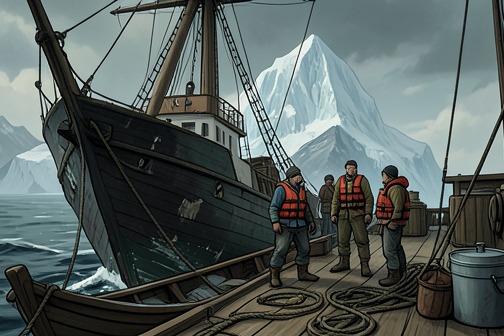
The [Sinking of the Percival after striking an iceberg](entity:event-recall-event-cb7c4ed7f783) was a maritime disaster that cost eighteen lives and erased the value of a full cargo of blubber. It also became a dividing line in [Arthur Brownlee](entity:character-recall-character-arthur-brownlee-bfa920c90ba4)’s life at sea: although the loss left the surviving crew unable to resume their former work, [Brownlee](entity:character-recall-character-brownlee-46030f891557) eventually returned and commanded another ship.
## The Loss and Its Cost
The [Percival](entity:object-recall-object-percival-42d5d205acb8) was crushed by an iceberg three years before the disaster was discussed in the book. Its holds were full of blubber, but not a single barrel was recovered. Eight men drowned and ten more died from the cold. Those who survived received no meaningful share of the lost cargo’s value; none made even sixpence from it.
The disaster therefore meant more than the destruction of a ship and its freight. The crew’s labor had produced a valuable cargo, yet the sinking left no recoverable return for the men who had survived. Its stark arithmetic—eighteen dead, a lost hold, and no payment to survivors—makes the episode an early illustration of how the hazards of whaling could transfer the consequences of commercial loss onto crews.
## Brownlee After the Wreck
Brownlee survived and, unlike the other survivors, returned to sea. The account describes the others as too profoundly affected by the disaster to go back; Brownlee alone managed to continue. His return is presented as evidence of stubbornness, or perhaps poor judgment, rather than as proof that the sinking had left him untouched.
The wreck also shaped his prospects as a captain. A captain associated with such a disastrous loss would not ordinarily be expected to secure another ship, yet Brownlee did. His later command of the [Volunteer](entity:object-recall-object-volunteer-3c8c66647ff2) thus carries the history of an unlikely return: the Percival’s loss was not the end of his seafaring career, even though it ended that of the other survivors.
## Memory and Significance
The Percival recurs as part of Brownlee’s account of his own past. When he tells stories of the coal barge and the wreck, he does not present his history as something to hide; he treats past mistakes and suffering as experiences a man must bear. Elsewhere, the memory is linked to the practical fact that he was the only survivor who went back to sea. The wreck consequently functions both as a catastrophe in its own right and as a measure of the persistence that distinguishes Brownlee from the rest of the surviving crew.
The episode also stands against the book’s account of a declining whaling industry. Brownlee recalls an earlier period when a successful voyage could return with great quantities of valuable whalebone, while later whaling required costly machinery and luck. The Percival’s lost blubber makes that commercial exposure concrete: a cargo could be accumulated through dangerous labor and then vanish in a single encounter with ice, leaving neither the goods nor a payment for the men who had survived.
Event 5
Henry Drax's assault on Albert Stubbs
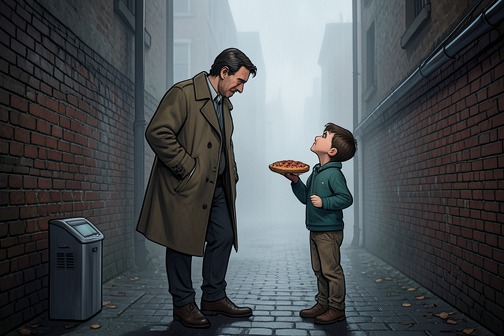
Henry Drax’s assault on [Albert Stubbs](entity:character-recall-character-albert-stubbs-7e5e3c84209e) is a sudden act of violence against a boy living at the margins of Hull’s waterfront. The encounter turns on Drax’s mistaken expectation that he can control the situation: when Stubbs directs him toward a boatyard, Drax suspects a trap and responds with fury rather than withdrawing.
## The Encounter in Hull
Drax spends an hour searching for Stubbs, who sleeps in a brick culvert beneath the north bridge. The boy survives on scraps and occasional small payments for errands run for waterfront tavern-goers waiting for ships. Drax approaches with an offer of food and shows him money taken from a Shetland sailor, presenting himself as someone willing to buy what the boy wants.
They walk together through Wincomlee and Sculcoates, past the Whalebone Inn and the timber yards, and stop at Fletcher’s bakery. Drax waits while Stubbs eats a meat pie. Afterward, the boy indicates a place beyond the boatyard where they can go. Drax immediately interprets this direction as a plan to ambush and rob him. He regards Stubbs’s apparent misjudgment of him with contempt, but that reaction shifts into anger; the offer of assistance has become a confrontation in Drax’s mind.
## Escalation and Assault
Drax tries to make the encounter happen immediately, but Stubbs refuses and again directs him toward the boatyard. When the boy touches his elbow to indicate the route, Drax treats the gesture as confirmation that Stubbs is leading him into a trap. His suspicion becomes the occasion for violence: he attacks Stubbs, renders him unconscious, and sexually assaults him.
The narration emphasizes the cold sequence of Drax’s actions rather than presenting the assault as a loss of control. Drax feels neither pleasure nor relief, and that absence intensifies his aggression. The scene marks a collapse of the distinction he makes between being deceived and being deprived: unable to accept that the encounter has not delivered what he wanted, he turns Stubbs into the object of his anger. The courtyard is consequently presented as a place where the boy’s life is violently altered, while Drax is shown acting with deliberate, untroubled brutality.
## A Recurring Vulnerability
The episode’s significance extends beyond Drax’s encounter with Stubbs: the novel later returns to the sexual abuse of a cabin boy aboard the [Volunteer](entity:object-recall-object-volunteer-3c8c66647ff2), when Sumner finds evidence that [Joseph Hannah](entity:character-recall-character-joseph-hannah-1ff9739961d4) has been abused. That case unfolds under shipboard authority, where [Brownlee](entity:character-recall-character-brownlee-46030f891557) moves Joseph to steerage but says the matter must be dropped if the boy will not identify his assailant. The parallel places Stubbs’s exposure to violence beside a later failure to establish accountability, without identifying Drax as Joseph’s abuser. Together, the episodes show how vulnerable boys can be harmed while the circumstances and responsibility remain difficult to bring into the open.
## Narrative Significance
The scene’s shift in perspective is itself consequential: Stubbs is introduced through the conditions of his poverty and briefly gives directions, but the confrontation is then organized around Drax’s interpretation of those directions. The narrative establishes Drax’s suspicion, not independent proof that the boy’s proposed route was a trap; that gap makes clear how readily Drax converts uncertainty into permission for violence. Stubbs’s intentions remain unresolved, and the evidence presented here does not establish what happens to him afterward.
Event 6
Sumner falls through Arctic ice and is rescued
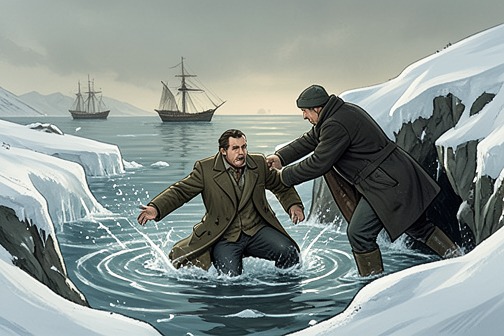
[Patrick Sumner](entity:character-recall-character-patrick-sumner-a3f07694d051)’s fall through the ice and rescue turn an ordinary sealing expedition into a near-fatal test of endurance. Separated from the other hunters on unstable floes, he falls into [Arctic](entity:location-recall-location-caaa3bc49b04) water, cannot pull himself out, and receives no immediate help. [Black](entity:character-recall-character-black-9a228068f885) eventually finds him and raises the apparently lifeless surgeon from a crevice; [Otto](entity:character-recall-character-otto-b03057fe2235) and two other searchers carry him back to the [Volunteer](entity:object-recall-object-volunteer-3c8c66647ff2). Sumner survives an immersion lasting about three hours and begins recovering aboard ship.
## The sealing hunt and its dangers
The incident takes place after the Volunteer sails north from [Lerwick](entity:location-recall-location-1a079416e0be) through fog, sleet, and gales. On the eleventh day, the weather settles and the crew encounters sea ice near Jan Mayen Island. They prepare for sealing with rifles and other equipment, and, two days after first seeing the main seal pack, lower their boats. The hunt is commercial work as well as a physical undertaking: [Brownlee](entity:character-recall-character-brownlee-46030f891557) counts the skins and estimates their value, while competition from Dutch, Norwegian, Scottish, and English ships makes a promising catch something to pursue quickly.
After the first hunt, Brownlee decides to send a sixth boat, putting Sumner in it with [Cavendish](entity:character-recall-character-cavendish-52b5040e27a1), the steward, the cabin boy, and several crewmen who had been reluctant to work. The boat reaches a group of seals after rowing southeast. The hunters kill three adults and six young seals, while the remaining animals escape. Cavendish then climbs a pressure ridge and points the party toward other locations. The group disperses across the ice, carrying out a task in which distance from the boat, physical exertion, and shifting floes all complicate the return.
By noon, Sumner has killed six more seals and is about a mile from the whaleboat, hauling roughly a hundred pounds of skins. He sees Cavendish ahead and another hunter farther off, but neither is close enough to hear him when he calls. Sumner is fatigued from pulling the load, and he is already managing a bad leg. His thoughts turn to the warmth of his cabin and the laudanum he takes each evening; the drug is part of his private routine during the voyage, while the hunt requires him to rely on his body and keep moving across the ice.
## The fall and the struggle to get out
At a gap about a yard wide between two floes, Sumner throws his rope across and prepares to jump. From experience, he knows to take off from his bad leg and land on his good one. As he steps forward, however, his standing foot slips sideways. He pitches into the water instead of clearing the gap. The fall separates him abruptly from the work party and leaves him in a position where neither the boat nor the other hunters can immediately help.
Sumner gets his hands onto the ice edge, but the surface will not give him enough purchase to climb out. His arms are weakened by the morning’s work, and the rope cannot support his weight because the skins attached to it are too light. The nearby floes are shifting, adding the danger that he could be caught between them; remaining in the water also threatens to leave him unconscious. He calls for Cavendish, whom he believes may have seen him fall, but no one answers. The scene makes the hunt’s risks concrete: the same dispersed movement that enables the crew to cover the seal pack also leaves a man alone when he falls.
Sumner tries repeatedly to raise himself onto the floe. On his third attempt he uses his elbow as a pivot and manages to lift part of his upper body above the edge. The floe shifts, his hold fails, and he falls back into the water. The narrative keeps the episode centered on effort rather than on a rescue already in progress: at this point he has no assistance, and the rope is of no use to him. He is eventually left wedged between two floes, with his head and shoulders above the water and the rest of his body below.
## Black’s rescue and return to the ship
Black finds Sumner in that crevice and initially cannot tell whether he is breathing. He fastens a sealing rope around Sumner’s chest, pulls him sideways to free him, and hauls upward. Sumner’s body comes loose; Black then grabs his coat and brings him fully onto the ice. When Sumner does not respond, Black strikes his face until an eyelid flickers open. Black’s actions transform the episode from an unobserved accident into a rescue, but he does not attempt the return alone.
Black fires his rifle twice to summon help. About ten minutes later, Otto arrives with two other members of the search party. The four men carry Sumner back to the ship, one taking each limb. His wet clothing has frozen stiff, making the journey difficult, and the men use a block and tackle to lift him aboard. Brownlee looks down at him and asks whether he is breathing; Black confirms that he is. The rescue thus depends on several stages of help: Black locates and frees Sumner, the signal brings the searchers, the group transports him, and the ship’s crew gets him onto the deck.
## Recovery and consequences
Once aboard, Sumner cannot initially speak. Black helps him sit up and feeds him bouillon from a teacup, but after two spoonfuls Sumner stops taking it. When he can speak, his first request is for laudanum. Black tells him that he was in the water for three hours and that an ordinary man would not survive such an immersion. Sumner does not remember the water or the cold, although he retains a brief memory of looking up at the snow-filled sky before losing awareness. The request for the drug immediately reasserts the dependence that had accompanied him during the hunt, even as his survival makes clear that the episode has not ended his voyage.
In the weeks after the rescue, as the Volunteer travels from Jan Mayen Island toward Cape Farewell, Sumner regains color, energy, and appetite. He walks the deck for exercise and sketches in his journal. His recovery also leads back into the ship’s labor: after whales are killed, he is assigned to move heavy blocks of blubber from the foredeck down to the hold. The work leaves him bruised and aching, but he experiences satisfaction in completing it and, for once, sleeps without laudanum. The fall therefore marks both a severe interruption and a return to physical participation. Sumner’s later work does not erase his vulnerability, but it shows him resuming a place in the expedition after the crew has brought him back from the ice.
Event 7
Joseph Hannah's murder and concealment in a ballast cask
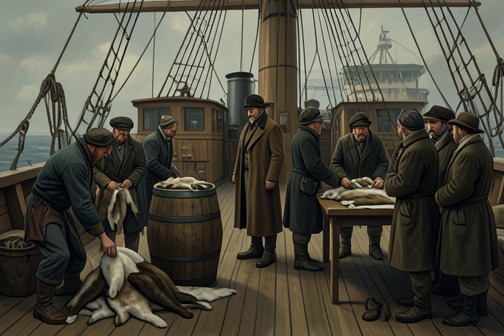
[Joseph Hannah’s murder](entity:event-recall-event-joseph-hannah-s-murder-d6523167bb72) and concealment in a ballast cask expose the danger of a shipboard community that recognizes signs of harm but fails to protect the person at its center. Before Hannah is found dead, [Patrick Sumner](entity:character-recall-character-patrick-sumner-a3f07694d051) reports that his examination revealed he had been assaulted. The boy does not identify anyone responsible, and the captain accepts that silence as a reason to take no further action. His eventual discovery in a barrel transforms an unresolved report into a murder investigation aboard the [Volunteer](entity:object-recall-object-volunteer-3c8c66647ff2).
## Background and Warning
The circumstances leading to the murder are established during the ship’s sealing voyage. After days of difficult weather north from [Lerwick](entity:location-recall-location-1a079416e0be), the crew reaches the seal pack and begins hunting. Henry Drax works alone across the ice, killing seals while the other men gather the skins. The voyage is organized around labor and expected returns: [Arthur Brownlee](entity:character-recall-character-arthur-brownlee-bfa920c90ba4) counts the skins, estimates their value, and presses the hunt forward as competition from other whaling ships closes in. In this setting, Hannah’s vulnerability is noticed but does not become the crew’s priority.
When Sumner tells [Brownlee](entity:character-recall-character-brownlee-46030f891557) that an examination of Hannah disclosed an assault, Brownlee briefly stiffens and asks how it occurred. Hannah gives no account. Later, when the captain asks him directly who was responsible, he remains silent. His silence leaves the circumstances unclear, but it does not erase Sumner’s concern: Sumner insists that Hannah has been grievously assaulted and that the responsible man is aboard the ship.
Brownlee nevertheless treats the absence of an accusation as a limit on what can be done. He says that if Hannah will not identify an attacker and maintains that no assault occurred, the matter cannot be pursued further. Sumner proposes seeking witnesses, but [Cavendish](entity:character-recall-character-cavendish-52b5040e27a1) responds with a snort. The exchange ends without an inquiry that establishes what happened or safeguards Hannah. The captain’s authority, the surgeon’s warning, and the boy’s inability or unwillingness to speak do not combine into protection; instead, the case is left unresolved.
## Discovery and Examination
The unresolved concern becomes a murder investigation when a cooper, examining a damaged ballast cask, finds Hannah’s body inside. The discovery links the ship’s ordinary work and storage spaces to the crime: the barrel had held ballast water, and the body had remained concealed there until the cooper looked inside. Hannah is carried to the mess cabin and laid on a table for Sumner to examine, while the assembled crew watches in silence. Sumner recognizes that his medical training cannot undo what has happened; in this moment he can only inspect the evidence and establish what it shows.
The examination identifies strangulation, and Sumner records further signs of severe violence, including fractures and missing teeth. These findings make clear that Hannah’s death was not an unexplained disappearance or an accident, but a killing preceded by assault. Brownlee responds with anger and promises that the guilty man will be taken to England in chains and hanged. His declaration marks a sharp change from the earlier decision to let the matter drop, but it comes only after Hannah has been found dead; the crew’s attention now turns to identifying the killer and accounting for how the crime went unnoticed.
## Responsibility and the Limits of Proof
Sumner can place his last sighting of Hannah on the day before the first flensing, but that detail does not establish when or where the boy was killed. The interval matters: Hannah had first come to the officers’ attention as a possible victim, then remained unaccounted for until his body was found. The examination supplies evidence of violence, but not the identity of the person responsible. At the mess-cabin table, Cavendish looks away and whispers to Drax; the narration gives no content for the exchange, so it registers as an unanswered gesture rather than proof of either man’s involvement.
Brownlee’s response is shaped by more than the crime itself. He regards a child’s murder as unprecedented aboard a whaling ship and fears the damage it will do to his final voyage and reputation. Inwardly, he assigns responsibility to [Baxter](entity:character-recall-character-baxter-249e6b7b19d1), whose choice of crew and larger scheme, he believes, set the disaster in motion; this is Brownlee’s judgment, not evidence identifying Hannah’s killer. The gap between what the captain suspects, what the medical examination establishes, and what the crew can prove leaves the investigation under pressure from competing forms of responsibility: personal guilt, command, and the legal promise of punishment.
## Neglected Warning and Retrospective Meaning
After [Joseph Hannah](entity:character-recall-character-joseph-hannah-1ff9739961d4) and his companions fail to come to Sumner’s cabin as requested, Sumner considers looking for them in the forecastle but decides the matter can wait until morning. His concern is already curdling into impatience: he privately regards the boy as a hopeless case and entertains explanations that diminish the force of what he had observed. He then returns to The Iliad and reaches for the key to the medicine chest. This hesitation does not establish what happened to Hannah or who was responsible, but it complicates the image of Sumner as the lone advocate who had done all that could be done. He recognizes signs of harm, yet does not pursue the boy when an opportunity to follow up presents itself.
In retrospect, the murder’s concealment in a ballast cask gives physical form to the distance between noticing danger and acting on it. The warning had entered the ship’s official conversation, but Hannah remained without an identified protector; only the discovery of his body makes the crew’s neglected concern impossible to set aside. The event’s significance lies not in a proven account of every step leading to his death—the evidence presented here does not supply one—but in the stark reversal from an unresolved report to a public demand for punishment. Brownlee’s promise comes after the loss, when the ship must confront both the killing and the failure to notice it in time.
Event 8
Joseph Hannah’s murder
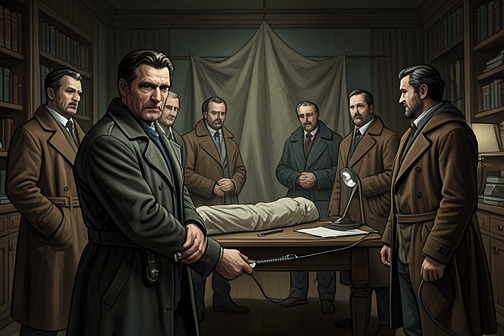
[Joseph Hannah’s murder](entity:event-recall-event-joseph-hannah-s-murder-d6523167bb72) is the concealed crime that turns the boy’s death at sea into evidence against Henry Drax. The novel first presents the aftermath as an absence—the boy is dead, and his body has been committed to the water—then gradually makes the violence legible through Drax’s thoughts and the discovery of [Joseph Hannah](entity:character-recall-character-joseph-hannah-1ff9739961d4)’s tooth in his arm.
## Death and Immediate Concealment
After Joseph Hannah’s body is wrapped in canvas and dropped over the ship’s stern, Henry Drax listens as the others continue to discuss the boy. His private reflections establish that he killed him and treat the killing as one act among ordinary bodily acts, without remorse or a sense of moral distinction. That inward account makes the disposal at sea more than a final consequence of the death: it is the circumstance that initially leaves the crew talking about a victim who can no longer speak for himself.
## The Tooth as Evidence
The murder becomes materially legible when [Patrick Sumner](entity:character-recall-character-patrick-sumner-a3f07694d051) examines a small lump beneath the skin of Henry Drax’s arm. A child’s tooth, broken at the root, emerges from the wound. Sumner recognizes it at once and shows it to [Brownlee](entity:character-recall-character-brownlee-46030f891557); Drax pulls his arm away and denies that the tooth is his. The object links Drax’s injury to Joseph Hannah and transforms a concealed killing into evidence the crew can inspect.
The tooth’s later return to conversation sharpens the contrast between proof and denial. Sumner identifies Drax’s right arm as the one in which Joseph Hannah’s tooth had been embedded. Drax dismisses the wound as a nick, calls himself a quick healer, and says he cannot explain how the tooth got there. His evasion does not resolve the clue: the tooth remains a physical trace of the violence, even as Drax refuses to acknowledge what it implies.
## The Murder Within a Wider Pattern of Concealment
Joseph Hannah’s murder belongs to a voyage increasingly shaped by efforts to make profit and conceal how it is obtained, though the evidence does not establish that the killing was part of the ship’s insurance scheme. [Baxter](entity:character-recall-character-baxter-249e6b7b19d1) presents Brownlee with papers and emphasizes the prospect of dividing twelve thousand pounds three ways; later, [Campbell](entity:character-recall-character-campbell-6984e4d13865) warns that the ship must be sunk in a way that will not invite questions from the underwriters. The contrast is consequential: the voyage’s commercial fraud depends on controlling how events appear, while Drax’s killing is exposed through a physical trace he cannot explain away.
The two forms of concealment converge in Sumner’s later account of the danger surrounding the ship’s scuttling. He accuses Baxter of having [Cavendish](entity:character-recall-character-cavendish-52b5040e27a1) sink the [Volunteer](entity:object-recall-object-volunteer-3c8c66647ff2) and says that Drax and he were the only people who might have known or guessed what had happened. Sumner describes a plan in which Drax would shoot him and [Stevens](entity:character-recall-character-stevens-ab88828cbfb2) would then shoot Drax, leaving the deaths to appear resolved; the plan fails. This later accusation does not make Joseph Hannah’s murder part of the insurance plot, but it places Drax’s concealed violence within a voyage where deaths and appearances are repeatedly treated as things that can be arranged.
## The Warning Sumner Misses
In the period before the murder, Patrick Sumner has reason to suspect that Joseph Hannah has been harmed: the boy will not identify who hurt him, or even acknowledge that what happened was abuse. Yet when Joseph and his companions fail to come to Sumner’s cabin after supper, Sumner considers looking for them in the forecastle and then decides the matter can wait until morning. Frustration shapes his judgment; he treats Joseph as a hopeless case and gives weight to Henry Drax’s description of the boy as a liar. Sumner briefly tries to imagine the world from Joseph’s perspective, but recoils from the effort and returns to his book and medicine chest. This missed opportunity does not establish that Sumner could have prevented the murder, but it gives the later discovery a second consequence: the evidence identifies Drax, while also exposing how readily the boy’s distress had been discounted.
Event 9
Drax frames McKendrick for Hannah's murder
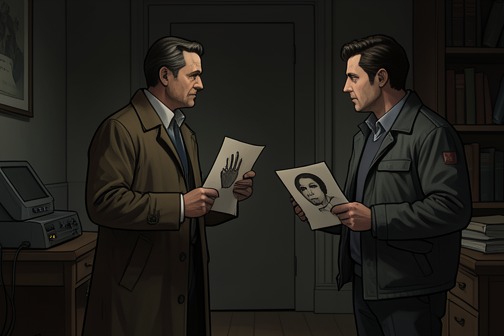
[Drax frames McKendrick for Hannah's murder](entity:event-recall-event-8d82f8daecce) by turning an invented eyewitness account into evidence against a vulnerable shipmate. The episode is not simply a mistaken identification: Drax exploits [McKendrick](entity:character-recall-character-mckendrick-e4a98a6a2662)’s reputation and Captain [Brownlee](entity:character-recall-character-brownlee-46030f891557)’s desire for a manageable suspect, while [Patrick Sumner](entity:character-recall-character-patrick-sumner-a3f07694d051) tests the accusation against physical evidence. The resulting conflict exposes how easily suspicion can harden into apparent certainty when the person accused is already discredited.
## The accusation takes shape
After [Cavendish](entity:character-recall-character-cavendish-52b5040e27a1) insists that McKendrick is the murderer, Drax listens to the discussion and recognizes that the case lacks a witness who can place the carpenter with Hannah. He volunteers that he has seen the two together. When Sumner asks when, Drax initially offers an evasive explanation for why he had not mentioned it earlier. He then accompanies the others to Brownlee’s cabin, where the captain has McKendrick brought up in irons and orders Drax to repeat his account in front of him.
Drax’s testimony is specific enough to sound like an observed fact: he claims he saw McKendrick touching Hannah’s body and attempting to embrace him beside the deckhouse. The location and purported conduct give the accusation a concrete shape, but the specificity comes from Drax, not independent corroboration. In the earlier discussion, Drax himself judges McKendrick too timid to kill someone. The contrast between that assessment and his later testimony makes the accusation’s function plain: it supplies the witness the case needs, not a reliable explanation of the murder.
## Reputation and convenient certainty
Cavendish has already treated McKendrick’s sexual reputation as proof of guilt. He says that men will testify to the carpenter’s alleged misconduct and argues that this is enough to establish his culpability. When Sumner points out the absence of convincing proof, Cavendish again substitutes reputation for evidence. His certainty rests not on a demonstrated connection to Hannah’s death but on the assumption that a stigmatized man is inherently suspect.
Brownlee does not simply accept every detail without question: he warns McKendrick that lying will bring severe consequences, and Sumner examines him for signs of a struggle. Yet Brownlee also has a practical reason to keep him in custody. He hopes Sumner is wrong because releasing McKendrick would leave the ship without an easy replacement suspect and bring further trouble. The inquiry therefore takes place under pressure to preserve an existing conclusion. McKendrick’s reputation makes him seem plausible to the officers, while the captain’s convenience makes that plausibility useful.
## Sumner tests the story against the body
Sumner’s challenge turns on details that the accusation cannot explain away. He recalls the paired marks on Hannah’s neck and asks how McKendrick could have made them with his injured hand. McKendrick’s left thumb is damaged beyond repair. When Sumner sets the hand injury beside the pattern of the marks, McKendrick begins to recognize the force of the contradiction: if he lacks two functioning thumbs, the particular marks cannot have been made by him as alleged.
The evidence is not merely a question of whether McKendrick had an opportunity to approach Hannah. Sumner connects an observable physical limitation to the form of the injuries, making the distinction between a suspicious reputation and a viable account of the killing. He also points to the records in his sketchbook, whose diagrams preserve details of Hannah’s injuries. Brownlee dismisses those drawings as inconclusive and gives greater weight to the claim that McKendrick was seen with Hannah and to the carpenter’s reputation. Sumner answers that the damaged thumb makes it physically impossible for McKendrick to have committed the crime in the manner indicated by the marks.
## Institutional resistance and later meaning
Brownlee maintains his authority as captain and keeps McKendrick confined, leaving the question unresolved aboard ship despite Sumner’s argument. He proposes that Sumner can present his opinion to a magistrate after they return to England. Sumner warns that this delay may allow the actual killer to leave the ship and disappear. The disagreement is therefore consequential: the dispute concerns not only which explanation fits the evidence, but whether evidence will be acted upon in time.
Later, in the timber yard, Sumner describes a larger plot in which Cavendish sank the [Volunteer](entity:object-recall-object-volunteer-3c8c66647ff2) and Drax and Sumner were the only men who might have known or guessed what happened. He says the intended sequence was for Drax to shoot him and for [Stevens](entity:character-recall-character-stevens-ab88828cbfb2) to shoot Drax, leaving matters apparently settled, but that the plan misfired. [Baxter](entity:character-recall-character-baxter-249e6b7b19d1) calls Sumner’s reasoning sharp while denying that it is correct, then stresses that two men lie dead and that Sumner killed one of them. This later exchange does not make Baxter’s denial a confession; it does show how the earlier framing belongs to a wider pattern of calculated deception and managed appearances. In the case against McKendrick, Drax’s false testimony supplies an appearance of certainty, while Sumner’s attention to the damaged thumb reveals how fragile that certainty is.
Event 10
Drax exposed and attacks Brownlee
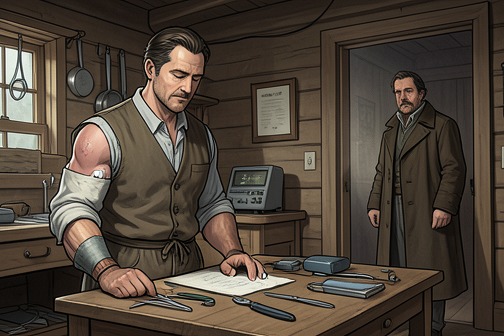
The exposure of Henry Drax’s crimes turns on a small object recovered during an examination: a child’s tooth lodged in his arm. [Patrick Sumner](entity:character-recall-character-patrick-sumner-a3f07694d051) recognizes its evidentiary force, but the discovery does not lead directly to an orderly arrest. Drax responds with violence, striking [Arthur Brownlee](entity:character-recall-character-arthur-brownlee-bfa920c90ba4) and fighting [Cavendish](entity:character-recall-character-cavendish-52b5040e27a1) before [Black](entity:character-recall-character-black-9a228068f885) intervenes. The scene makes the tooth both proof and catalyst: a fragment that changes what the men know, then precipitates an immediate struggle over who can act on that knowledge.
## The Wound and the Discovery
[Brownlee](entity:character-recall-character-brownlee-46030f891557) notices that Drax’s right arm is swollen and directs him to show it to the surgeon, explaining that an injury to the arm could keep him from harpooning or rowing. The wound, high on the forearm near the elbow, is infected. Sumner recommends opening it and drawing out the remaining infection, and asks why Drax did not come for treatment earlier. Drax dismisses the injury as a minor nick, a denial that contrasts with the condition Sumner can see and examine.
As Sumner presses the small lump beneath the skin, it shifts and emerges from the wound. He catches the object in the padding and recognizes it at once: a child’s tooth, broken at the root. Its scale and appearance sharply distinguish it from the surrounding medical materials. A moment earlier, the men were dealing with an injury that might interfere with the ship’s work; now the examination has produced an object Sumner treats as evidence of a crime.
Drax immediately denies that the tooth belongs to him, even after Brownlee points out that it came from his arm. Sumner answers that it is evidence sufficient to see Drax hanged. The claim changes the encounter from a medical consultation into an attempted confrontation with the consequences of Drax’s actions. The scene establishes what Sumner and Brownlee believe the tooth proves, while leaving the object itself to carry the force of the revelation: it has been concealed within Drax’s body, but treatment makes it visible to others.
## From Exposure to Violence
Brownlee goes to the cabin door and calls for the first mate. Drax refuses the prospect of being chained and threatens the men. While Brownlee calls again for Cavendish, Drax surveys the cabin for weapons without immediately reaching for one. The table holds a brass sextant; a wall rack contains a spyglass and a heavy whalebone walking stick with an ebony pommel. These objects, ordinary fittings of the cabin until the crisis, become part of the scene’s immediate calculation of force.
Cavendish enters as the others turn toward him. Drax seizes the whalebone stick and strikes Brownlee, then attempts another blow before Cavendish restrains his arm. The struggle shifts from a threat against Brownlee to a physical contest with Cavendish. When the stick falls, Cavendish reaches for it; Drax instead grabs him and strikes him with a knee, leaving him on the floor. The attack disables both men who might have helped contain Drax, while Sumner remains present but has not intervened.
Sumner is still holding the lancet used in the examination and the tooth recovered from Drax’s arm. That juxtaposition gives the episode its distinctive structure: the instrument and evidence belong to the attempt to treat and expose, while the walking stick becomes a weapon used to resist the consequences. Sumner asks what escape could accomplish, but Drax says he will take his chances in a whaleboat rather than return to England to be hanged. His stated objective is escape from arrest, not a defense of the tooth or an explanation of its presence.
## Black’s Intervention and the Turn in Control
Drax orders Sumner to turn around and begins dressing while Sumner faces the cabin wall. Sumner considers the possibility of calling out but does not do so; he closes his eyes and waits, believing a fatal blow may follow. The pause leaves the surgeon exposed and makes the arrival of help a sudden reversal rather than the result of his own action.
A commotion outside is followed by a shotgun blast as the cabin door opens. Black stands in the doorway, aiming the second barrel at Drax. He orders Drax to hand the stick to Sumner and threatens to shoot him if he refuses. Drax pauses, then yields the weapon. Black enters and sees Brownlee and Cavendish unconscious on the floor. The balance of control has changed: Drax had used the cabin’s objects and the men’s divided attention to attack, but Black’s armed presence ends his immediate advantage.
The episode closes with Drax looking down at the tooth on the table where Sumner left it. Its position makes the contrast plain without resolving the larger legal outcome: the evidence remains visible, while the man it implicates is now disarmed and confronted by Black. The discovery has exposed Drax, but it has also shown how quickly proof can give way to threatened escape and violence. The scene’s reversal is therefore practical as well as moral: the tooth alters the meaning of the examination, and Black’s intervention prevents Drax from turning that revelation into an escape through force.
Event 11
Volunteer deliberately scuttled in Lancaster Sound
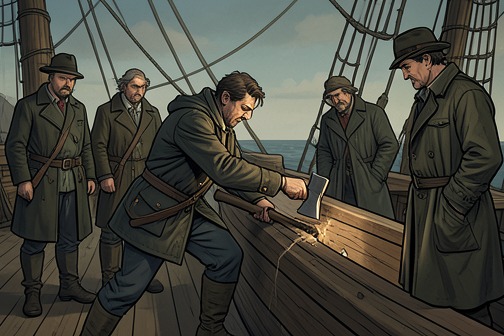
The deliberate scuttling of the [Volunteer](entity:object-recall-object-volunteer-3c8c66647ff2) in [Lancaster Sound](entity:location-recall-location-13f4c16a4246) converts an attempted insurance deception into a genuine maritime disaster. [Cavendish](entity:character-recall-character-cavendish-52b5040e27a1) first expects the ice to destroy the ship and provide a plausible account of its loss; when the hull proves more resilient than he anticipated, he takes an axe to its timbers. The sequence exposes the gap between a staged accident and the deliberate act required to make that accident real, while placing the crew’s labor and survival inside a scheme organized around financial gain.
## Commercial Scheme and Its Cover
The plot grows out of a voyage in which whaling is both the public purpose and, for the conspirators, a lesser source of profit. Years earlier, [Baxter](entity:character-recall-character-baxter-249e6b7b19d1) had warned [Brownlee](entity:character-recall-character-brownlee-46030f891557) that the industry had changed: modern whaling demanded costly steam power and specialized weapons, and even a well-equipped ship might return without a catch. Brownlee nevertheless insisted he could fill the hold. In a separate conversation, Baxter produced papers and emphasized that twelve thousand pounds divided three ways would exceed what Brownlee could expect to earn from whales. He described money as a force that followed its own course, an explanation that makes commercial pressure sound inevitable even as he participates in a particular arrangement.
The voyage does yield catches. After the Volunteer sails north from [Lerwick](entity:location-recall-location-1a079416e0be), the crew prepares rifles and knives for sealing, and five whaleboats return laden with skins. Later, Brownlee estimates that a whale will provide ten tons of oil and at least half a ton of whalebone, worth close to nine hundred pounds if market prices hold. Those working returns establish the contrast at the heart of the scheme: hunting and processing animals require coordinated, dangerous labor, while the planned sinking promises a much larger financial return. Sumner, otherwise unoccupied, is assigned to carry heavy blocks of blubber from the deck into the hold; his work makes the ship’s ordinary commercial purpose tangible even as others prepare its destruction.
The insurance deception depends on appearance as well as loss. [Campbell](entity:character-recall-character-campbell-6984e4d13865) warns that the whales are a relatively small part of the plan and that an opportunity to sink the ship convincingly may not come again. The timing must avoid suspicion from the underwriters; Campbell also fears being trapped if the ship waits too long. Earlier, the crew had been told that Campbell was waiting somewhere ahead in the [Hastings](entity:object-recall-object-hastings-2dd14c26230b), though the vessels would not meet or communicate until the moment was right. The voyage therefore carries a concealed second itinerary: the visible work of whaling, and a planned loss whose circumstances must look credible to those assessing the claim.
## Ice, Preparation, and Failed Expectation
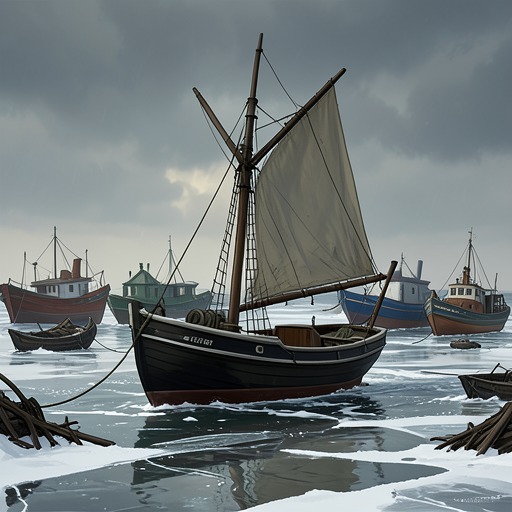
When the wind shifts from south to north, loose drift ice begins moving toward the Volunteer. Cavendish orders the crew to cut an ice dock into the land floe for protection. The operation requires ice saws, gunpowder, ropes, and poles. [Black](entity:character-recall-character-black-9a228068f885) marks out the dock, and the men work in teams with long saws suspended from wooden tripods. They cut through ice six feet thick to make sides two hundred feet long, then divide the floe into sections. This strenuous communal work temporarily gives the crew a practical defense against the advancing pack, but the same setting becomes a potential instrument in the plan to lose the ship.
Cavendish initially treats the pressure of the ice as an adequate means of destruction. He says that if the Volunteer does not sink at once, he can sink it later. Drax observes that a later sinking will not look as convincing, and the two discuss the crew’s position on the fast ice: Campbell could warp back if a lead opened, while the other men believe the ship has already been stove in and are unlikely to interfere. Cavendish insists the ship will not survive the pressure. Drax counters that the ship can survive if Cavendish allows it to, and offers to damage it directly with an axe. The exchange makes the central problem plain: the conspirators need not merely a wreck, but a wreck that can pass as the consequence of ice.
## Deliberate Damage and the Ship’s Loss
Cavendish and Drax go below with a lantern and an axe to inspect the forehold. They move casks aside and find water entering through a breach where the timbers have separated and the caulking has fallen away, but there is no evidence of serious damage. The discovery overturns Cavendish’s expectation that the ice has already done the work. Drax explains that the ship bent without breaking and tells Cavendish that it will not sink unless he makes it do so. Cavendish reaches for the axe.
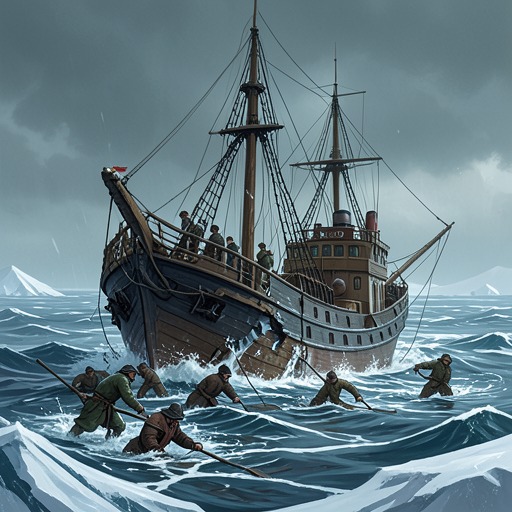
After a brief confrontation, Cavendish turns away and strikes the already dampened timbers repeatedly. The ship begins to take on the damage that the ice alone had failed to inflict. Within two hours, the Volunteer has pitched forward until its bowsprit lies against the ice, and its foremast has broken. Cavendish sends Black aboard with a team to salvage the booms, spars, and rigging and to cut down the remaining masts before they also break away. With the masts removed and only the stern visible above the surrounding ice, the vessel has been reduced from a working ship to a wrecked remnant. Sumner, contemplating it afterward, questions how he had ever trusted a structure of wood, nails, and rope to keep him safe.
## Exposure and Significance
The sinking’s staged appearance does not erase its deliberate cause. The ice provides a plausible setting, but the discovery of limited damage in the hold and Cavendish’s axe blows show that the ship’s destruction required human action. Campbell’s warning about appearances and the underwriters gives that action its commercial context: the conspirators are managing not only the loss but the story that will account for it. The attempt to make fraud resemble accident thus depends on controlling evidence, timing, and the movements of the people who might know what happened.
Later, Sumner states his understanding of the scheme to Baxter: he accuses Baxter of having Cavendish sink the Volunteer and describes an intended chain in which Drax would shoot him and [Stevens](entity:character-recall-character-stevens-ab88828cbfb2) would then shoot Drax, leaving the witnesses dead. Baxter denies the account and turns the conversation toward the two men dead in the timber yard, one of whom Sumner killed. The accusation does not undo the ship’s loss, but it reframes it as part of a larger plan and identifies Baxter as a participant whom Sumner believes responsible. The event’s decisive reversal is therefore double: the Volunteer survives the ice that was meant to destroy it, only to be deliberately damaged, and the supposed maritime accident later becomes evidence in the conflict over who profited and who would be left to answer for the deaths.
Event 12
Hastings disappears in Lancaster Sound
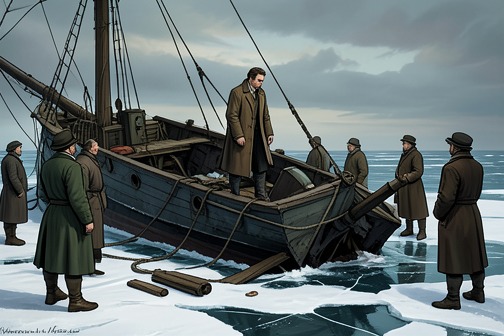
The disappearance of the [Hastings](entity:object-recall-object-hastings-2dd14c26230b) in [Lancaster Sound](entity:location-recall-location-13f4c16a4246) converts an unexplained absence into a confirmed shipwreck: after the vessel fails to return from the pack, wreckage reveals that an iceberg smashed it apart and that everyone aboard was lost. The event destroys the stranded crew’s expected source of rescue and gives sudden, material force to the [Arctic](entity:location-recall-location-caaa3bc49b04) dangers that had until then shaped their work and plans.
## Commercial Plans and the Northern Passage
The loss occurs against a background of declining returns from whaling and a venture in which commercial calculation has become entangled with deliberate risk. [Arthur Brownlee](entity:character-recall-character-arthur-brownlee-bfa920c90ba4) knows that the industry has changed since the days when a boat and harpoon might bring a fortune. He recalls that the Aurora returned in June with abundant whalebone, but now a large steam engine, harpoon guns, and luck may still fail to produce a profitable catch. [Jacob Baxter](entity:character-recall-character-jacob-baxter-22168a812264) puts the proposed alternative in concrete terms: twelve thousand pounds divided three ways is more than [Brownlee](entity:character-recall-character-brownlee-46030f891557) could expect to earn by killing whales. The documents he brings make the sum part of their immediate business discussion, while Brownlee’s guarded response shows that [Campbell](entity:character-recall-character-campbell-6984e4d13865)’s presence is important to the plan.
[Baxter](entity:character-recall-character-baxter-249e6b7b19d1) presents money as a force that does not follow the participants’ preferences: block one route and it finds another. That fatalistic account sits beside the practical arrangements surrounding the [Volunteer](entity:object-recall-object-volunteer-3c8c66647ff2) and the Hastings. Brownlee knows that the Volunteer’s unusually heavy insurance could invite scrutiny, and the men involved therefore depend on appearances as well as outcome. When Brownlee later meets Campbell aboard the Volunteer, Campbell urges him not to delay the planned sinking: the whales are secondary, and the accident must look convincing enough not to provoke the underwriters. The Hastings, with Campbell waiting aboard it farther up the strait, is part of this concealed arrangement, although the evidence does not establish that its later destruction was planned. Its disappearance instead becomes a catastrophe that overtakes the scheme and the men connected with it.
The ships’ movements through the north take place amid changing weather and difficult ice. After sailing from [Lerwick](entity:location-recall-location-1a079416e0be) through fog, sleet, and gales, the crew reach sea ice near Jan Mayen Island and begin sealing. The hunt yields a valuable start: Brownlee estimates that four hundred seal skins could produce nine tons of oil. Later, in the [North Water](entity:location-recall-location-north-water-7169912dc245), the crew strikes whales; after the first whale is killed, Brownlee estimates its oil and whalebone at nearly nine hundred pounds. These catches offer an apparent answer to the industry’s declining prospects, but they do not make the ships secure. By the time the fleet gathers near [Pond’s Bay](entity:location-recall-location-pond-s-bay-2243f6131a02), dense ice delays progress, and the pack remains an active hazard rather than a passive setting.
## The Hastings Vanishes
At the moment the absence becomes apparent, the men are living on the ice after their ship has been crushed. They have raised the one surviving tent, repacked the whaleboats, and are waiting for [Black](entity:character-recall-character-black-9a228068f885), Jones, and the others to return from the Hastings. When fog lifts, [Cavendish](entity:character-recall-character-cavendish-52b5040e27a1) goes out with a telescope to watch for the party. He calls for [Otto](entity:character-recall-character-otto-b03057fe2235), who in turn summons [Patrick Sumner](entity:character-recall-character-patrick-sumner-a3f07694d051), then hands Sumner the telescope and indicates the eastern distance. Sumner expects to see the crew towing four empty whaleboats across the ice. Instead, the view offers no sign of them.
Otto states that the Hastings is gone. Cavendish’s earlier composure gives way to agitation, but he initially explains the absence as a temporary movement into the pack to escape the icebergs. He insists that Campbell knows their position and will return. Sumner recognizes that the ship may have been sunk; Cavendish rejects that possibility and repeats that it must still be somewhere in the sound. The disagreement is consequential: the crew must decide whether to trust the expectation of the ship’s return or act on the possibility that it has been damaged beyond recovery.
Otto proposes searching in the whaleboats. The wind had been fierce, he points out, and the Hastings could have been driven far to the east, stove in, trapped in the ice, or left without a rudder. Cavendish reluctantly accepts that a search is necessary, though he continues to predict that the ship will be found nearby. His insistence does not rest on evidence that the vessel is safe; it expresses the hope that the disappearance is temporary, at a time when the crew have few alternatives.
## Wreckage and Confirmation
The search produces evidence rather than the missing ship. The men find a capsized whaleboat, followed by a broken trail of empty blubber casks and shattered timber extending for about half a mile. They row in slow circles, retrieve pieces from the water, examine them, and let them go again. The wreckage makes the absence legible: the Hastings has not simply moved out of sight, and there is no returning party to guide the stranded men to safety.
Cavendish scans the surrounding floes with his telescope but sees no one. He is pale and silent, his usual bluster displaced by the scale of the loss. Some men weep; others pray. Otto consults the charts and takes a sextant reading, identifying their position as past Cape Hay and proposing that they can reach Pond’s Bay before night, where another ship might be found. Cavendish answers that, if no ship is there, they may have to winter over. The suggestion marks the practical consequence of the Hastings’s disappearance: rescue has not become impossible, but the plan to depend on this particular vessel is gone.
The cause is stated with certainty when Sumner is told that the Hastings was sunk, smashed to pieces by an iceberg, with everyone aboard drowned. The subsequent discovery of wreckage confirms the substance of that report. The narrative first presents an empty horizon and competing interpretations, then lets the broken boat and cargo debris establish the disaster. This sequence makes the ship’s disappearance more than a navigational mystery: it is the irreversible loss of a vessel, its crew, and the rescue the stranded party had expected from it.
Event 13
Cavendish kills Bannon during the camp mutiny
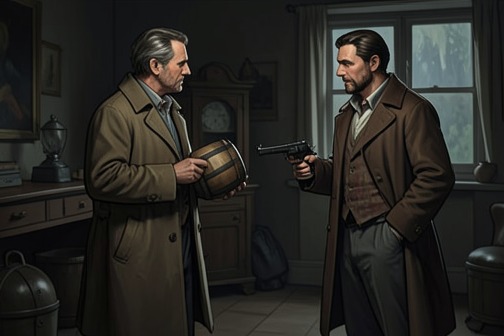
[Cavendish kills Bannon during the camp mutiny](entity:event-recall-event-544dd3949c0d) after a day of fruitless searching for the missing [Hastings](entity:object-recall-object-hastings-2dd14c26230b) has left the stranded crew exhausted, cold, and increasingly hostile. A quarrel over drink becomes a fight; when Bannon charges [Cavendish](entity:character-recall-character-cavendish-52b5040e27a1) with a barrel stave, Cavendish shoots him. The killing abruptly silences the camp and makes the struggle over command unmistakable: with [Brownlee](entity:character-recall-character-brownlee-46030f891557) gone, Cavendish can hold authority only by showing that he is prepared to use lethal force.
## Background and mounting pressure
The confrontation occurs after the [Volunteer](entity:object-recall-object-volunteer-3c8c66647ff2)’s crew has been driven from the ship and forced to live in a makeshift camp on the ice. The men have spent the day rowing east along the land ice and north across broken drift ice, searching for the Hastings. They find neither the ship nor any indication of what has happened to it. Sumner, recently promoted to steersman, hopes that sighting the vessel might ease his fear, but the search ends in uncertainty. Among the crew, anxiety has hardened into bitterness and anger, and Cavendish’s disputed promotion to captain makes him an obvious target for their resentment.
Their hardship belongs to a voyage already shaped by commercial pressure and concealed plans. Before sailing, Brownlee insisted he could still fill the hold, while [Baxter](entity:character-recall-character-baxter-249e6b7b19d1) reminded him that twelve thousand pounds divided three ways would exceed what Brownlee could expect to earn from whaling. The exchange frames the expedition as both a hunt for whales and a venture in which money could redirect the ship’s purpose. Later, [Campbell](entity:character-recall-character-campbell-6984e4d13865) warns Brownlee that the Volunteer must be sunk in a way that will not prompt questions from the underwriters. These plans do not establish a direct cause for the camp fight, but they place its failing command structure inside a voyage where private financial interests and the crew’s exposure to danger are sharply at odds.
The work itself has offered intermittent success, not security. North of [Lerwick](entity:location-recall-location-1a079416e0be), Drax kills seals across the ice, and Brownlee calculates the possible value of the skins. Later, [Black](entity:character-recall-character-black-9a228068f885) strikes the crew’s first whale in the [North Water](entity:location-recall-location-north-water-7169912dc245); its carcass is estimated to yield ten tons of oil and more than half a ton of whalebone, worth close to nine hundred pounds at market. Such figures make the voyage’s commercial promise tangible, but they do not protect the men once the ship is lost and the crew is stranded. At the camp, the immediate facts are simpler: no work can be done, the Hastings remains absent, and the men must wait.
## From disorder to gunfire
That evening, the cook prepares a meal from salt beef and old turnips. Cavendish taps a cask of brandy and has a ration distributed. The men take more without waiting for permission until the cask is empty. The gathering grows unstable; after a spell of drunken argument, a fight breaks out and someone draws a knife. [McKendrick](entity:character-recall-character-mckendrick-e4a98a6a2662), who is watching rather than fighting, is cut deeply in the forearm, and the blacksmith is knocked unconscious. The violence is already spreading beyond a contest between the men who began the quarrel.
Cavendish tries to intervene but is struck on the head with a belaying pin. Sumner and [Otto](entity:character-recall-character-otto-b03057fe2235) pull him outside to keep him from being beaten further. Otto returns to calm the men, but they abuse him and threaten him with the knife. Cavendish gets back to his feet, takes two loaded rifles from the whaleboats, and gives a third to Otto. He enters the tent again, fires into the ice to draw the men’s attention, and declares that he remains captain in Brownlee’s absence. His threat is not an attempt to settle the dispute by persuasion; it announces that any further challenge may be answered with a bullet.
Bannon, a Shetlander wearing silver hoops in his ears, picks up a barrel stave and rushes Cavendish. Cavendish shoots him. The other men respond with a roar of dismay, then fall silent. Cavendish drops the empty rifle and takes a loaded one from Otto. He warns the crew that the confrontation has cost a man his life and that he may shoot again if crossed. The killing thus follows a clear escalation: intoxication and argument give way to a general fight; attempts at intervention fail; Cavendish returns armed; Bannon’s charge is met with lethal force.
## Consequences and significance
The immediate consequence is both Bannon’s death and the end of the open confrontation. The scene does not present a restored, consensual order. Instead, Cavendish secures a pause through a show of armed power, while the men are left to reckon with the fact that challenging him can be fatal. Otto’s presence on both sides of the intervention is also significant: he first tries to calm the camp, then supplies Cavendish with a loaded rifle, placing him within the desperate effort to control the violence.
The episode makes the instability of Cavendish’s captaincy concrete. His authority is already described as unearned and tainted by violence; here, in Brownlee’s absence and with the crew stranded, he enforces it himself. The episode’s value turns sharply from the possibility of holding the camp together to death and fear. That turn does not resolve the crew’s larger predicament—the Hastings is still missing, and the men remain on the ice—but it changes the terms on which they must endure it. Command has become inseparable from the threat of further violence.
Event 14
Four crewmen perish after leaving winter camp
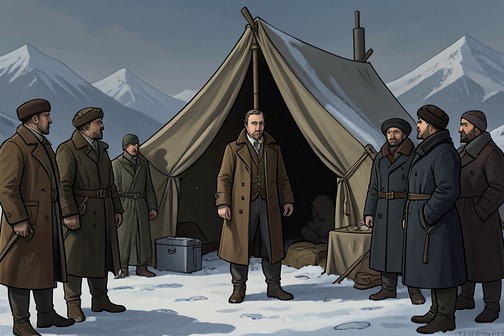
[Four crewmen perish after leaving winter camp](entity:event-recall-event-d9f0c826e9db) when Webster, [Samuel McKendrick](entity:character-recall-character-samuel-mckendrick-85facafc6468), the cook, and a Shetland sailor depart despite warnings that they may not survive beyond a night in the open. Their deaths are learned only later, through hunters who find the men frozen in a ruined tent. The episode makes the split within the stranded party concrete: leaving is an act of refusal, but the country beyond camp offers little chance of safety or return.
## Causes and Conditions
The immediate dispute grows from the men’s exhaustion and anger at the expedition’s orders. Webster says that they have followed orders since leaving Hull and that obedience has brought them to their present desperate situation. When others urge them to stay, he refuses to remain even an hour longer. Samuel McKendrick, the cook, and the Shetland sailor join him, turning his individual decision into a four-man departure.
The danger is made explicit before they go. [Patrick Sumner](entity:character-recall-character-patrick-sumner-a3f07694d051) warns Webster that the men have no tent, furs, or familiar landmarks to guide them; even if the winter camp is nearby, they may never find it. Sumner judges that they might survive one night in the open, but not two. The warning is practical rather than abstract: the men will leave without the basic shelter and clothing needed to endure the journey, in a place without roads or recognizable tracks.
## Departure from Camp
The men’s decision is accompanied by visible strain. Webster gathers his possessions with stiff, jerky movements, while Samuel McKendrick’s face is wet with tears and open sores mark his face and neck. The cook is shivering. [Otto](entity:character-recall-character-otto-b03057fe2235) tries to persuade them to wait, eat at the tent, and set out at first light, but they ignore him; when pressed, they raise their fists, and Webster threatens to knock down anyone who tries to stop them.
They leave shortly afterward without ceremony or extended farewell. Patrick Sumner gives each man a share of frozen seal meat, and Otto provides Webster with a rifle and cartridges. The departing men and those who remain exchange brief handshakes but do not try to soften the implications of the separation. Their dark outlines recede into the blank landscape, leaving the camp’s warnings unanswered by any further negotiation.
## Discovery and Aftermath
Half a week later, two hunters arrive by sledge at the mission station. They tell the priest that they found a ruined tent a day’s journey away, with four dead white men frozen inside. The salvaged objects they show him—knives, ropes, a hammer, and a grease-stained Bible—confirm that they have encountered a camp, not simply bodies scattered on the route. The account does not establish the precise cause or timing of each man’s death, only that the four who left were found dead together in the ruined shelter.
The hunters decline to return for the bodies, explaining that they must continue hunting. They try to trade the Bible to the priest; when he refuses, they give it to [Anna](entity:character-recall-character-anna-ea2421a71401). Anna then tells the priest that the hunters also found two dead men at the white men’s camp. They had been stripped, and one had been killed with a knife. These additional deaths deepen the account of violence surrounding the abandoned camp, but the hunters’ report does not identify who was responsible.
## Significance
The departure is both a rupture in the group and a test of how far individual refusal can go in an environment where survival depends on shelter, supplies, and cooperation. The men reject the authority of the orders that brought them north, yet their choice does not free them from the conditions imposed by the [Arctic](entity:location-recall-location-caaa3bc49b04). Sumner and Otto offer food and a weapon, but cannot make the route safe or ensure that the four can find their way back.
The delayed discovery also shapes the episode’s effect: the departure is first presented as an unresolved separation, then retrospectively fixed as a fatal one by the hunters’ report. The ruined tent and the objects recovered from it provide the few material traces of the men’s last days. Their fate stands beside, but remains distinct from, the report of the two other men found dead at the camp.
Event 15
Drax escapes winter camp and kills Cavendish
## Background and Escape Plan
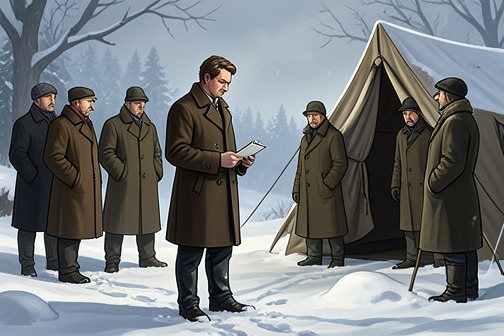
Drax’s escape from the winter camp grows out of a decision to leave rather than remain with the others. He tells [Cavendish](entity:character-recall-character-cavendish-52b5040e27a1) that a local hunter is due to depart on a sledge the next morning and has agreed to take him. To make that plan possible, Drax asks Cavendish for a file to remove his chains and for a moment of deliberate inattention. Cavendish does not agree to help; Drax proceeds without his assistance.
The cold makes the work of freeing himself slow and difficult. Drax can manage only about twenty minutes outside the tent before losing feeling in his hands and feet, so he makes four trips through the night, returning each time to continue working on his manacles. He threads his way among the sleeping men, who stir and curse but do not wake; Cavendish alone watches him. The repeated movement between the tent and the freezing darkness turns escape into a patient, physical task rather than a sudden flight.
Once free, Drax feels newly awake and unburdened by fear of what comes next. He gathers his clothes into a bundle, keeps the file, and makes his way to the snow house where the two hunters are sleeping. The contrast between the camp’s sleeping bodies and Drax’s deliberate preparations establishes the danger of the escape before anyone else understands what he intends to do.
## Killing the Hunters and Taking the Sledge
Drax enters the snow house while the two hunters sleep. He kills them both, then takes the elder hunter’s anorak and locates the blubber knives and rifle. The killings clear his route out of the camp, but they also make the escape a lethal one: Drax has turned the hunters’ shelter and equipment into means of survival for himself.
Outside, he retrieves the deerskin traces and harnesses the dogs to the packed sledge. He returns once more to the snow house to gather the dead men’s boots, trousers, and mittens, placing them in a sleeping bag. By the time he comes back out, Cavendish is waiting by the sledge. Drax has acquired transport and supplies, but his departure now depends on what he will do about the man who has watched him prepare.
## Cavendish’s Death and the Camp’s Response
Cavendish waits beside the sledge, still observing Henry Drax’s preparations. Drax directs him to look inside the sleeping bag, then uses the moment when Cavendish bends down to kill him with a single stroke of a blubber knife. He turns Cavendish’s final inspection into an ambush, and afterward searches [Brownlee](entity:character-recall-character-brownlee-46030f891557)’s greatcoat. The escape has now become not only a flight from the camp but the elimination of the one man who had watched it take shape.
Drax’s parting words assign the idea to Cavendish, though the deaths of the two hunters and Cavendish are the means by which Drax has secured his own departure. The statement sharpens the reversal between them: Cavendish had believed he could prevent Drax from getting ahead of him, but Drax leaves him dead beside the sledge while the dogs and supplies are ready to go.
At first light, the camp finds Cavendish’s body on the snow. The men initially suspect the two hunters, only to discover that both are dead as well and that Henry Drax has disappeared. The three deaths leave them stunned, unable to make sense of the sequence until they recognize that Drax has escaped. The scene turns the camp’s practical uncertainty into a collapse of trust: the danger they first attribute to outsiders has come from within their own group.
Under [Otto](entity:character-recall-character-otto-b03057fe2235)’s direction, the men bury Cavendish in a shallow trench at the headland and cover him with stones taken from the cliff. They leave the hunters where they were found, blocking the snow-house entrance and collapsing its walls and roof over them. After these separate, improvised burials, Otto gathers the survivors to pray for mercy and for the dead. The act offers a fragile form of order, but it cannot answer the immediate fact that Henry Drax has left the camp, or restore the men’s confidence in one another.
## Earlier Pattern of Work and Violence
The escape also extends a pattern established during the sealing: Henry Drax works alone, moving methodically between groups of seals, killing them and preparing their skins while the other boats load their catches. His competence is presented through repetitive physical labor, not reflection; he keeps moving until the ice is marked by the hunt and the five whaleboats carry their loads back. That earlier work makes the winter-camp killings part of a broader narrative in which practical skill and violence are difficult to separate. Drax’s actions repeatedly turn bodies, tools, and the surrounding environment into means of continuing forward. The escape brings that instrumental approach into the camp itself, where the equipment and transport associated with survival become inseparable from the deaths that enable his departure.
Event 16
Sumner kills a polar bear and survives a blizzard inside its carcass
[Patrick Sumner](entity:character-recall-character-patrick-sumner-a3f07694d051)’s pursuit of a bear carries him away from the camp and into a blizzard, where the hunt becomes a test of whether he can endure the [Arctic](entity:location-recall-location-caaa3bc49b04) rather than simply kill his quarry. After shooting the animal, he loses his bearings in the storm, takes shelter within its carcass, and survives enclosed in the warmth of its body.
## Setting and Background
The episode grows out of a voyage shaped by exposure, physical work, and the pursuit of diminishing returns. Sailing north from [Lerwick](entity:location-recall-location-1a079416e0be), the crew endure fog, sleet, bitter winds, and gales before reaching the ice near Jan Mayen Island. They prepare for sealing by distributing rifles and ammunition, and then work across the ice in five boats. Henry Drax hunts alone, while the crew’s accumulated skins become cargo whose value [Arthur Brownlee](entity:character-recall-character-arthur-brownlee-bfa920c90ba4) calculates in oil and money. The sequence establishes the practical violence of the voyage: animals are taken for their commercial yield, and work depends on bodies moving through hazardous conditions.
The ship’s commercial aims continue northward. [Brownlee](entity:character-recall-character-brownlee-46030f891557) expects to find whales in the [North Water](entity:location-recall-location-north-water-7169912dc245), explaining that they have moved away from the harpoon into more dangerous, ice-filled waters. When the crew finally encounters a whale, the hunt requires coordinated boats and repeated strikes; afterward, the crew strip the carcass for oil and whalebone. The catch is weighed in market terms, while the labor of processing it falls to the men aboard. Sumner, though the ship’s surgeon, is also put to work carrying heavy blocks of blubber to the hold. He nearly falls in, is saved by [Otto](entity:character-recall-character-otto-b03057fe2235), and finishes the day bruised and aching but satisfied by the exertion. That experience links the distant bear hunt to a wider pattern in the voyage: survival and profit alike are pursued through exhausting physical labor.
## The Pursuit Across the Ice
While keeping watch for the bear, Sumner falls asleep and dreams of fishing in summer at Bilberry Lough, a calm, familiar scene sharply unlike the Arctic around him. On waking, he sees the bear approach two bodies and fires at it. The shot wounds rather than stops the animal, and Sumner leaves camp to follow its tracks across the snow, convinced it will soon weaken. As the chase continues, that practical expectation gives way to fixation: he recognizes that he has gone too far to bring the bear’s meat back, yet keeps following it across pressure ridges and open ice. The bear leads him through a narrow opening in dark cliffs into an enclosed, ice-choked fjord. The place seems strangely familiar to Sumner, as though anticipated in a dream, but he continues onward even as hunger and the pain in his injured leg wear him down. When a blizzard erases the bear, cliffs, and landmarks from view, he loses his sense of direction and reaches shelter almost by chance. The hunt has carried him beyond the useful limits of a planned expedition; with the storm closing around him, pursuit becomes a struggle to remain alive.
## The Storm, the Vision, and the Kill
As the blizzard intensifies, Sumner loses sight of the bear and the landscape dissolves around him. He stumbles to shelter behind a boulder, exhausted, numb with cold, and convinced that he has failed. In this extremity he sees the dead boy from his earlier vision, now present in the storm; the sight brings grief and shame, and Sumner weeps. The vision vanishes, leaving him with the storm and the bear. He reloads his rifle and calls out, then sees the animal emerge through the snow. With his attention narrowed to the immediate act, he fires and kills it.
The kill does not end the danger. Sumner is still far from camp, and the blizzard continues to obscure his surroundings. He opens the bear’s carcass and takes in its warmth, then lowers himself into the emptied body and draws the dead flesh around him for protection. There, enclosed against the wind, he tries to speak and remembers Homer, but his damaged tongue leaves him unable to form words. The episode makes survival depend not on mastery of the Arctic but on an intimate, unsettling use of the animal’s body: the bear he pursued becomes his shelter from the storm.
## Narrative Significance
The episode unsettles the distinction between hunter and hunted without turning the bear into a simple emblem. Sumner follows it as prey, but his survival ultimately depends on the body he has killed. The reversal is practical as well as symbolic: in a landscape where ordinary shelter and orientation have failed, the animal becomes the means by which a human body can endure. The scene thus shifts the measure of success from possession of the quarry to continued existence alongside the consequences of the hunt.
That bodily dependence also unsettles Sumner’s claim to the forms of identity associated with learning and speech. He recalls Homer while enclosed in the carcass, yet cannot make the words emerge; the remembered epic stands against his involuntary, inarticulate sounds. The contrast does not erase his knowledge, but places it under pressure from cold, hunger, and physical vulnerability. Survival comes first, while the language through which he might interpret or announce himself fails him. The bear’s warmth preserves a life whose customary markers of human composure and expression have temporarily broken down.
Event 17
Volunteer sinks in Baffin Bay
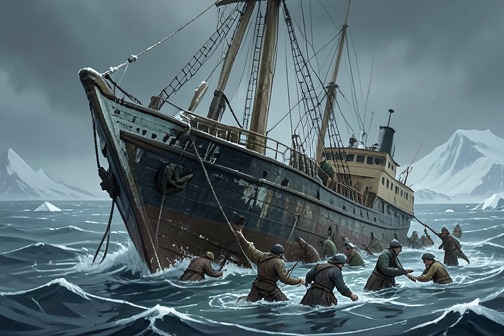
The sinking of the [Volunteer](entity:object-recall-object-volunteer-3c8c66647ff2) is not simply a maritime disaster: the evidence presents it as the intended outcome of an insurance scheme, designed to make deliberate destruction appear to be an unavoidable encounter with [Arctic](entity:location-recall-location-caaa3bc49b04) ice. The plan grows out of a failing whaling business, depends on the timing and appearance of the loss, and ultimately leaves [Patrick Sumner](entity:character-recall-character-patrick-sumner-a3f07694d051) with an account that its surviving beneficiary has every reason to discredit.
## Commercial decline and the insurance incentive
[Arthur Brownlee](entity:character-recall-character-arthur-brownlee-bfa920c90ba4) initially insists that he can still fill the ship’s hold, but [Baxter](entity:character-recall-character-baxter-249e6b7b19d1) argues that the conditions of the trade have changed. He contrasts the earlier days, when a boat and harpoon could bring wealth, with a present in which success requires expensive steam power, harpoon guns, and luck—and even then a ship may return empty. The shrinking prospects of ordinary whaling make the promised alternative especially potent: Baxter shows [Brownlee](entity:character-recall-character-brownlee-46030f891557) papers setting out £12,000 divided three ways, a sum he says exceeds what Brownlee could expect to earn from whales.
Brownlee’s response is wary rather than enthusiastic. He makes [Campbell](entity:character-recall-character-campbell-6984e4d13865)’s presence at the necessary moment a condition of the arrangement and says he will turn the ship home if Campbell is not there when needed. Baxter, meanwhile, describes money as a force that finds its own route, even when people would prefer to block it. His language makes the scheme sound both irresistible and impersonal, although the papers and the discussions show people arranging its terms.
The voyage also carries the appearance of a real commercial expedition. The crew sails north from [Lerwick](entity:location-recall-location-1a079416e0be) through rough weather, reaches the seal pack near Jan Mayen Island, and begins hunting. Brownlee counts the skins and calculates their possible oil yield and market value. Later, in the [North Water](entity:location-recall-location-north-water-7169912dc245), the crew kills a whale that Brownlee estimates could yield ten tons of oil and more than half a ton of whalebone, worth close to £900 if prices hold. The work and its returns provide a genuine commercial setting for the voyage, even as the insurance arrangement redirects attention from the catch to the ship itself.
## Concealing the arrangement in the Arctic
The connection with Campbell is meant to remain hidden until the time is right. Campbell waits aboard the [Hastings](entity:object-recall-object-hastings-2dd14c26230b) beyond Disko Island, while the two ships avoid meeting or communicating prematurely. The underwriters are described as alert to signs of conspiracy, and the Volunteer’s unusually heavy insurance already makes it suspicious. The plan therefore depends not only on causing a loss but on controlling when the ships are seen together and how the loss will appear.
Campbell makes that distinction explicit when he warns that the whales are of little importance beside the opportunity to sink the Volunteer convincingly. The timing must avoid attracting questions from the underwriters; waiting too long, however, risks trapping Campbell himself in the ice. The scheme thus turns on a narrow practical calculation: the ship must be lost at a moment when the surrounding conditions can plausibly explain what happened.
Those conditions are real. As the ships proceed through [Lancaster Sound](entity:location-recall-location-13f4c16a4246), a change in the wind sets drifting pack ice moving toward them. [Cavendish](entity:character-recall-character-cavendish-52b5040e27a1) orders the crew to cut an ice dock for protection. They work with ice saws, ropes, pulleys, and boarding pikes, cutting through ice six feet thick to make a dock with sides two hundred feet long. The labor gives the ship an apparent response to a genuine hazard. Yet Cavendish’s later remark that he can sink the Volunteer if it does not sink then, followed by his observation that a later sinking would not look as convincing because they have built the dock, joins the protective preparations to the plan’s concern with appearances.
## The planned loss and its cover story
The evidence establishes the intention to make the Volunteer’s destruction look like an ice casualty, but does not narrate the actual moment of sinking in these scenes. Its significance emerges through the planning beforehand and the competing explanations afterward. Much later, Baxter summarizes the account that is supposed to be available to the waiting world: both ships lost to ice, with Sumner miraculously rescued by passing Yaks. Sumner says he will not tell that story anytime soon, refusing to accept Baxter’s framing as the account he must give.
In a subsequent confrontation, Sumner lays out his understanding: Baxter had Cavendish sink the Volunteer; Drax and Sumner were the only men who might have known or guessed what had happened; and a sequence in which Drax shot Sumner and [Stevens](entity:character-recall-character-stevens-ab88828cbfb2) then shot Drax would have left the matter apparently settled. Sumner calls the outcome a misfire. Baxter denies that his reconstruction is right, but does not meet it with an account that resolves the conflict. Instead, he stresses that two men are dead, one by Sumner’s hand, and that Sumner needs his assistance.
## Exposure, silence, and consequence
Baxter turns the danger of disclosure back on Sumner. He argues that Sumner’s uncertain background and time in India would invite scrutiny, warns that the magistrate may not believe his explanation, and points out that the ships are already lost and the dead cannot return. He then offers fifty guineas for Sumner to put down his gun, leave the house, and begin again. The offer makes the aftermath part of the scheme’s concealment: money is again presented as a way to close off one route and open another, this time by buying the surviving witness’s silence.
The sinking therefore carries two linked consequences. It destroys the Volunteer and helps make a fabricated account of accidental loss plausible, while also placing the truth in the hands of a survivor whom Baxter can portray as legally and socially unreliable. The contrast between the crew’s visible labor against moving ice and the commercial calculation behind the ship’s intended loss gives the event its central irony: the Arctic danger is genuine, but the plan depends on making that genuine danger serve as cover for human design.
Event 18
Urgang and Merok's seal hunt
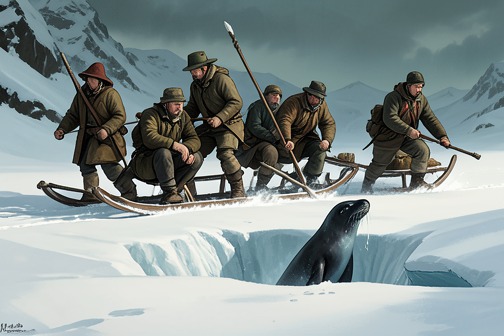
[Urgang](entity:character-recall-character-urgang-693178aa97ad) and [Merok](entity:character-recall-character-merok-23ebbb876243)’s seal hunt is a cooperative hunt on the sea ice that turns a practical act of subsistence into a decisive change in Sumner’s standing at the camp. Urgang patiently takes a seal at a breathing hole, Merok helps bring it out, and the animal is shared among the families. Because the catch is unusually large and Sumner has accompanied the hunters, the people around him begin to regard his presence as a source of luck. The episode joins detailed labor and local knowledge to Sumner’s uneasy experience of being assigned a sacred role he has not earned.
## Setting and Participants
The hunt follows Sumner’s arrival among the camp’s families. People sleep together on a raised platform of snow, branches, and hides, with little separation or privacy. In the morning [Punnie](entity:character-recall-character-punnie-8616cf503320), one of Urgang’s two wives, gives Sumner water while Urgang and Merok prepare the sledge. The hunters are quieter than they had been before, and Sumner suspects they are uncertain about the claims made for his supposed powers. That uncertainty matters: he is included in the expedition, but the hunters’ attention remains on the work, not on his interpretation of his own importance.
The party travels by sledge along the coastline for several miles before stopping at a place Sumner sees as indistinguishable from many they have already passed. The hunters remove the spears, secure the sledge by turning it over and setting it into the snow, and release one of the dogs to search for a breathing hole. The dog’s behavior helps identify the location; Merok takes hold of it and draws it away as Urgang signals Sumner to stay back. The sequence depends on observation, animal assistance, and practiced coordination rather than on Sumner’s intervention.
## Finding and Taking the Seal
Urgang approaches the hole with his spear held upright. He kneels to clear snow with his knife, looks into the opening, listens, and covers it again. He then places a piece of sealskin on the ice and stands on it, holding the iron-tipped spear horizontally while he waits. The stillness of this preparation contrasts with the suddenness of the strike: when the seal surfaces to breathe, Urgang drives the spear through the snow. Its head detaches from the shaft, leaving him to hold the line and resist the animal below the ice until it dies.
Merok joins Urgang to bring the seal out through the opening. They recover and reattach the spearhead, then close the wounds with ivory toggles to keep from losing more of the animal’s blood. The seal is exceptionally large, nearly twice the usual size. The hunters work with evident urgency and joy, but Sumner also notices an effort to contain that excitement, as though they do not want pleasure to overwhelm the significance of the moment. Together, the three return toward the sledge with the catch dragging behind them. Sumner experiences the outcome as an undeserved victory, although he has not performed the decisive work.
## Sharing the Catch and Sumner’s Reputation
Later, Urgang and Merok butcher the seal and distribute portions of meat and blubber to the other families in the camp. The catch thus becomes more than a private reward for the hunters: its products circulate among the community. The children gather around Sumner, touching his bearskin clothing and legs as if seeking a share of the good fortune associated with him. They disperse when the women come out of the igloos, but their response has already made the change in his status visible.
The seal’s size appears to confirm the belief that Sumner has magical powers. The camp’s people imagine that he can summon animals from below and draw them toward the hunters’ weapons; in their understanding, he is not a god but an intermediary who can assist or intercede. Sumner connects this role to the image of Saint Gertrude he remembers from [William Harper](entity:character-recall-character-william-harper-f6abd3869049)’s house in Castlebar. The comparison registers both the distance between his medical, rational self-image and the belief forming around him, and his unwillingness to dismiss that belief as simply absurd. He recognizes that the priest would judge the idea differently, but the priest belongs to another world from the one Sumner now inhabits.
## Hunting Knowledge and Narrative Significance
The episode presents the hunt as a sequence of specialized, interdependent actions: the dog locates the breathing hole, Merok manages the dog, Urgang waits and strikes, and both hunters recover and prepare the seal. Sumner’s presence does not make him the agent of the catch. Instead, the hunters’ skill produces the result, while the community’s interpretation makes him its supposed source. This gap between practical cause and attributed influence is central to the event’s meaning.
The scene also differs from the shipboard sealing elsewhere in the narrative. On the [Volunteer](entity:object-recall-object-volunteer-3c8c66647ff2), Drax works through groups of seals while the crew’s output is counted in skins and assessed for its expected return. Here, the focus rests on locating one animal, the hunters’ coordinated method, and the distribution of its meat and blubber among camp families. The contrast places commercial extraction beside a hunt whose immediate outcome is communal sharing, without suggesting that the latter is free of effort or danger. For Sumner, the episode brings physical subsistence, social belief, and his own uncertainty together: a catch he did not make becomes the occasion on which others assign him power.
Event 19
Sumner operates on the missionary's abdominal abscess
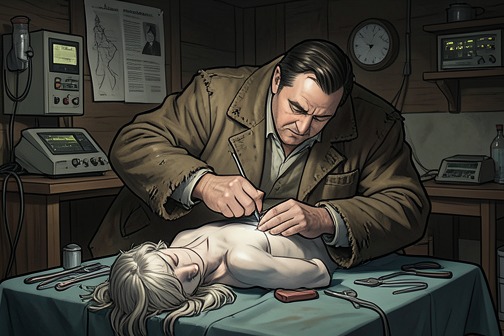
[Sumner operates on the missionary's abdominal abscess](entity:event-recall-event-b7d5a785e5d2) in a remote cabin, where the priest's worsening illness leaves him little time and few medical resources. The operation brings Sumner's practical surgical knowledge into direct contact with the limits of what he can know or control: he intervenes decisively, yet expects the priest may not survive. The priest is alive the next morning, and a later letter confirms that Sumner's actions are regarded as having saved his life.
## Diagnosis and Decision
The immediate crisis follows a night of escalating pain. [Anna](entity:character-recall-character-anna-ea2421a71401), who has been reading Saint Paul's letters to the Corinthians at the bedside, asks Sumner privately whether the priest is going to die. Sumner explains that an internal rupture has left the priest's abdomen filling with poison, but tells Anna plainly that he cannot save him by the means currently available. Her confidence that he will do so does not change his assessment. When she presses him for a reason behind the illness, he offers no consoling explanation; she returns to prayer while he remains focused on the condition itself.
The priest then deteriorates further. He suffers violent shivering, becomes cold and clammy, and has a faint, irregular pulse. When he cannot keep down the brandy Anna offers, Sumner leaves the cabin briefly. The surrounding sea ice appears empty beneath visible stars at noon, and the stillness gives his momentary retreat the scale of an encounter with isolation and possible death. He goes back inside rather than allowing that pause to become an escape from the immediate task.
Sumner finds Anna applying another poultice and prepares to operate. He identifies the cecum as abscessed or possibly ulcerated, while acknowledging that the precise distinction will not alter what he must do. Opium, which might otherwise help, is unavailable. He concludes that an incision is the best remaining way to release the diseased matter. The decision is urgent but not presented as certainty: before proceeding, he briefly considers whether the condition might instead be a hernia or tumor, then rejects those alternatives on the basis of his examination and reasoning.
## Preparation and Operation
The cabin's limited equipment shapes the procedure. Sumner takes ether, lint, and a lancet from the medicine chest, sharpens the instrument, clears the table, and wipes it down. He examines the priest and explains the proposed incision. When the priest asks how Sumner knows what to do, Sumner identifies himself as a surgeon. The brief exchange makes professional skill, rather than religious reassurance, the basis on which the operation proceeds; even so, Sumner tells the priest that success will require considerable luck.
Sumner brings the priest's brother in from the igloo and assigns the two helpers specific tasks. He uses ether to render the priest unconscious. Anna is told to watch for signs that the priest is waking and to administer more ether if necessary; her brother is given a bucket and towel and told to remain alert beside Sumner. The division of labor turns a small group with no established surgical facility into a working team. Anna's prayer is interrupted when Sumner needs her attention to the practical demands of the operation.
After checking the abdomen again, Sumner makes the incision and works through the tissue to reach the abdominal cavity. A large amount of infected material drains from the opening. The unexpected quantity startles those present: Anna cries out, her brother drops the bucket, and Sumner briefly recoils before resuming the work. He tells the brother to clean the table and dispose of the soiled rags in the stove. Together, the three turn the priest onto his side to aid drainage; Anna reapplies the ether when he begins to stir, while Sumner presses around the incision and the brother clears away the discharge. They continue until the flow stops.
## Immediate Aftermath and Survival
The priest is carried back to bed, covered, and given a dressing. Sumner washes his hands, opens the window, and gathers the medicines that may ease the priest's pain. He explains to Anna how and when to use them, then leaves the cabin to smoke. His assessment remains guarded: he doubts the priest will live more than a day and fears that damage to the gut could lead to further leakage and death. The operation has relieved the immediate pressure, but Sumner does not mistake that intervention for a cure or a guarantee.
By morning, however, the priest is still breathing and appears no worse than before. Sumner removes and replaces the dressing, inspects the wound, and attends to the seepage. The survival of the night is a limited but significant reversal of his expectation, not proof that the danger has passed. When the priest asks what Sumner found inside him, Sumner gives a restrained answer. His attention remains on the patient's condition rather than on claiming a successful outcome.
## Consequences and Significance
The episode establishes the difference between Sumner's medical competence and his power over the outcome. He diagnoses the abscess, makes a reasoned decision under uncertainty, organizes the available help, and performs a difficult operation with improvised resources. At the same time, the unavailable opium, the severity of the illness, and the possibility of further internal damage leave survival beyond his control. His work is neither a miracle attributed to faith nor a triumph he can confidently claim; it is an intervention carried out under conditions in which skill and luck coexist.
The operation also recurs later as evidence of Sumner's past. When [Baxter](entity:character-recall-character-baxter-249e6b7b19d1) reads a letter stating that Sumner saved the missionary's life, Sumner acknowledges what he did but attributes much of the result to luck. That later reference confirms the consequence that the cabin scene could not yet establish. In retrospect, the operation stands as a concrete instance of Sumner's identity as a surgeon: he may be uncertain about the patient's future, but when faced with an urgent need, he assesses, prepares, and acts.
Event 20
Shootout at the Hull timber yard
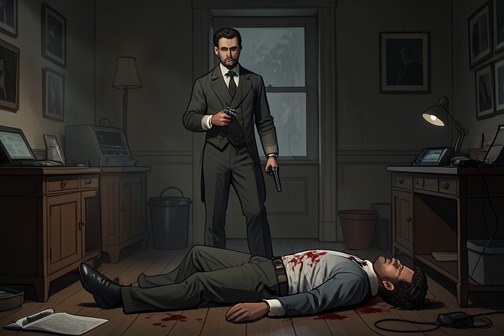
The [Shootout at the Hull timber yard](entity:event-recall-event-hull-8dac0466cbeb) is the violent breakdown of [Jacob Baxter](entity:character-recall-character-jacob-baxter-22168a812264)’s plan to dispose of both [Patrick Sumner](entity:character-recall-character-patrick-sumner-a3f07694d051) and Henry Drax while making their deaths appear to be a mutual killing. [Baxter](entity:character-recall-character-baxter-249e6b7b19d1) arranges the meeting as a trap, but Drax fires at the wrong man: [Stevens](entity:character-recall-character-stevens-ab88828cbfb2) dies, Sumner survives, and ultimately kills Drax himself. The intended crime scene, designed to erase the planner from the story, instead becomes the site where Baxter’s scheme fails and Sumner escapes with Drax’s revolver.
## Baxter’s Plan
Baxter sets the plot in motion after descending to the first-floor landing, where he summons Stevens from the hallway into the study and closes the door. Stevens has been reading the Hull and East Riding Intelligencer, his bowler on his knees. Baxter first checks that he has the revolver and bullets previously supplied to him, asks to inspect the weapon, and returns it. The exchange establishes that the killing is not an impulsive quarrel: Baxter is verifying the means before assigning Stevens a specific role.
At midnight, Stevens is to go to Sumner’s room at the Pilgrim’s Arms and claim that Baxter needs to see him urgently about important news concerning the [Volunteer](entity:object-recall-object-volunteer-3c8c66647ff2). Because Sumner does not know the town or Baxter’s house, Stevens can guide him towards the river, along Trippett and past the foundry, to the old timber yard. Baxter instructs him to get Sumner inside even if the explanation of a shortcut is not believed. Drax is to wait there and shoot Sumner; then Stevens is to shoot Drax. Baxter insists that he needs this order of events, although Stevens offers to shoot Sumner himself.
The planned aftermath is as deliberate as the invitation. Stevens is to put the revolver into Sumner’s hand, empty the pockets of both dead men, and leave. Baxter anticipates that a dock constable will hear the shots and find two bodies, each holding the weapon that killed the other. With no witnesses or other signs, he expects the police to treat the deaths as an unresolved mutual killing. He describes the result as freedom from Drax’s threats and demands. The scheme depends on a staged account of the deaths being more persuasive than the actual chain of responsibility.
## The Trap Misfires
Drax waits at the yard with brandy and his own revolver. Before the meeting, he drops the bullets while opening the cylinder and loses one; he counts the remaining ammunition as sufficient to kill Sumner. His private intention is more direct than Baxter’s arrangement: he expects to shoot Sumner as soon as the men enter, without warning or conversation. This difference matters. Baxter’s plan requires Drax to perform one assigned killing and then become the second victim, while Drax treats the encounter as an opportunity to act on his own terms.
Clouds obscure the moon, and the yard’s shadows merge as Drax waits near the gate. On hearing voices, he stands, cocks the revolver, and aims at the two figures entering side by side. He fires at the man on the left. When he approaches the fallen figure with a light, he discovers that he has killed Stevens, not Sumner. The central reversal is an error of identification produced by the darkness, but it also destroys the carefully ordered sequence Baxter had prepared: the person meant to lure Sumner has become Drax’s unintended first victim.
Drax understands that Sumner must still be somewhere within the walled yard, since he has not gone back through the gate. He calls for the surgeon and briefly offers to lay down his weapon for a fight without guns, but receives no answer. He then takes up the revolver again and searches towards a cabin at the far end of the yard. Its half-open door and broken, shutterless windows make it a possible hiding place. Drax knows that the shot may have drawn attention and that delay could bring discovery, yet he still has not located Sumner.
## Sumner’s Counterattack and Escape
Sumner is inside the cabin, holding a rusted saw blade and waiting. When Drax crosses the threshold, Sumner strikes him with it and kills him. The attack is sudden and unplanned in the sense that Sumner acts without pausing to deliberate; afterward, he is horrified by what he has done. He takes Drax’s revolver and hurries across the yard. The outcome reverses the intended roles in Baxter’s design: Drax, meant to kill Sumner and then be killed by Stevens, is killed by Sumner after mistakenly shooting Stevens.
Sumner leaves the yard and walks back towards town at a steady pace, without looking behind him. He enters a pub, orders a fourpenny ale and then another, and waits for his hands to stop trembling. He cannot manage to light his pipe and puts it away beside Drax’s revolver. The weapon is a concrete remnant of the failed plot: Sumner has it, rather than Stevens placing a revolver in his hand as Baxter had ordered. Sumner then asks the barman for a railway timetable, turning from the immediate danger in the yard towards a means of leaving town.
## Consequences and Significance
The event exposes the vulnerability of Baxter’s plan to the very conditions it attempts to control. Its success requires each participant to follow a precise sequence: Stevens must bring Sumner to the yard, Drax must shoot the intended target, Stevens must kill Drax, and the scene must support a false account of reciprocal violence. In the darkness, Drax’s shot kills Stevens instead, and Sumner’s survival leaves no possibility of the planned second killing. Baxter’s instructions about the revolver, the position of the shot, and the removal of the men’s possessions cannot compensate for the failed identification at the gate.
The shootout also brings the three men’s differing purposes into collision. Baxter intends to escape Drax’s threats by arranging a crime that appears to resolve itself; Drax intends to kill Sumner without waiting on Baxter’s elaborate staging; and Sumner, cornered inside the cabin, acts to survive. The aftermath does not show Baxter’s intended disappearance of responsibility. Instead, Stevens and Drax are dead, Sumner has taken Drax’s gun, and Sumner is seeking a railway timetable. The yard’s planned fiction of two men killing each other is replaced by a chain of events Baxter could not direct.
Event 21
Sumner robs Baxter and flees Hull
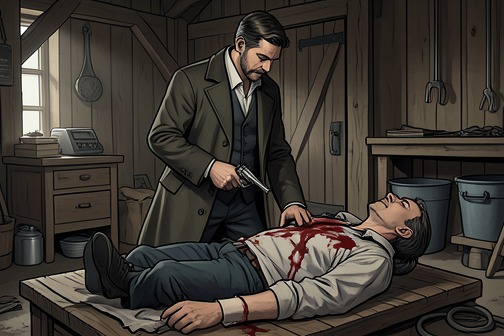
[Sumner robs Baxter and flees Hull](entity:event-recall-event-hull-4edbe3994175) after a confrontation that converts [Baxter](entity:character-recall-character-baxter-249e6b7b19d1)’s attempt to buy silence into a calculated escape. Baxter offers him fifty guineas and a clean departure; Sumner instead demands every penny in the safe, takes the money, and leaves Baxter bound in the stable. The flight carries him through northern England and into a new attempt to leave the country, while a newspaper report identifies him as a wanted man. The episode’s central reversal is not simply that Sumner takes the money: Baxter’s proposed settlement treats the past as something that can be paid away, but Sumner refuses the terms and makes his own future with the proceeds.
## The Scheme Behind the Confrontation
The encounter grows out of a commercial plot organized around the [Volunteer](entity:object-recall-object-volunteer-3c8c66647ff2) and its insured loss. Earlier, Baxter showed [Arthur Brownlee](entity:character-recall-character-arthur-brownlee-bfa920c90ba4) papers and emphasized that twelve thousand pounds, divided three ways, would far exceed what they could expect to earn killing whales. [Brownlee](entity:character-recall-character-brownlee-46030f891557)’s agreement was qualified: [Campbell](entity:character-recall-character-campbell-6984e4d13865) had to be present when needed, or Brownlee would turn the ship around and head home. The papers and the sum give the scheme a concrete financial stake, while Brownlee’s condition shows that its success depends on coordination rather than money alone.
Baxter describes money as a force that cannot be controlled, but the plot requires careful control of appearances. Campbell warns that the Volunteer must be sunk in a way that does not invite questions from the underwriters. The timing matters too: he wants the sinking to happen before he risks becoming trapped by the ice himself. When the ship is protected by a purpose-built ice dock, Henry Drax recognizes that letting it sink later would look less convincing. The dock therefore serves two purposes: it answers an immediate danger from moving ice and becomes part of the scene meant to make the loss appear plausible.
By the time Sumner confronts Baxter, the ships are sunk and Henry Drax is dead. Sumner accuses Baxter of arranging for [Cavendish](entity:character-recall-character-cavendish-52b5040e27a1) to sink the Volunteer and of relying on a chain of deaths to leave the affair neat and unexplained: Drax would shoot Sumner, then [Stevens](entity:character-recall-character-stevens-ab88828cbfb2) would shoot Drax. The plan did not unfold as intended. Sumner’s account makes the confrontation a reckoning over the scheme, but Baxter denies that Sumner has understood the situation correctly and redirects attention to the two dead men in the timber yard, one of whom Sumner killed.
## Baxter’s Offer and Sumner’s Reversal
Baxter presents himself as the person who can manage the danger. He points to Sumner’s uncertain background and former service in India, and argues that an investigation could expose him as well as Baxter. Since Drax is dead and both ships are lost, Baxter says, pursuing the matter cannot restore either the dead or the ships. His proposed solution is practical and self-interested: Sumner should leave, and Baxter will pay him for killing Drax, whatever the circumstances.
The offer is specific. Baxter unlocks the large iron safe in his study, takes out a brown canvas wallet, and gives it to Sumner, saying it contains fifty guineas in gold. He proposes that Sumner go to [London](entity:location-recall-location-1bfd335cdd1b), forget the Volunteer and Drax, and let Baxter invent a story to divert attention from the timber-yard killings. Sumner holds the wallet but does not agree. He recognizes that the moment has unsettled his sense of what comes next, yet Baxter’s money does not resolve the problem on Baxter’s terms.
Sumner places the wallet on the desk and demands the rest of the safe’s contents. Baxter treats the demand as though it might be a joke and offers twenty guineas more than the original payment. Sumner persists and orders him to fill a leather satchel. That change—from accepting a negotiated payment to taking the full contents—makes the encounter a contest over agency as well as money. Baxter had framed himself as the man who could buy a new beginning and arrange the story told afterward; Sumner takes control of the money and refuses to let Baxter set the price of his departure.
## The Escape from Baxter’s House
After Baxter fills the satchel, Sumner checks that the safe is empty. He binds Baxter’s hands with cord cut from a curtain, gags him with a napkin and cravat, and makes him lead the way to the stables. The route passes through the rear hallway and kitchen, out into an ornamental garden, and past its pond, fountain, potting shed, and gazebo. These ordinary domestic spaces become the passage from Baxter’s managed interior to Sumner’s escape.
In the stable, Sumner secures Baxter with a rope and warns him to remain quiet, telling him he may be found alive in the morning. He chooses an older gray horse rather than either of the two younger black horses. When it is unsettled, he rubs its neck and hums until it accepts the bit. He saddles it, carries the leather satchel, and leaves after checking that the mews is empty. The scene is presented as a sequence of practical decisions: restrain the man who could summon help, select a horse, prepare it, and depart without drawing attention.
At dawn Sumner is twenty miles north. He passes through Driffield, stops at Gorton to water the horse, and reaches Pickering late that night, hungry and short of sleep. At the inn he gives the name Peter Batchelor and claims to be traveling to see an ill uncle. He keeps Drax’s gun close while he sleeps, with the satchel hidden beneath the bed. The assumed identity and concealed money mark the next phase of the escape: Sumner is no longer simply leaving Baxter’s house but trying to make himself difficult to trace.
## Pursuit, Disguise, and Departure
The escape becomes more precarious when Sumner reaches Guisborough. He sells the horse and saddle for half their value, then reads a newspaper report at the railway station. The account of the Hull murder and robbery names [Patrick Sumner](entity:character-recall-character-patrick-sumner-a3f07694d051), identifies him as an Irish former soldier, describes the stolen horse, and reports Baxter’s reward for useful information. Sumner leaves the paper behind and boards a train to Middlesbrough with the satchel on his knees. Baxter’s promised ability to invent a story has not prevented a public account from identifying Sumner as the culprit; the report makes clear that the money has been taken at the cost of immediate exposure.
That night Sumner searches the dockside taverns for a foreign-speaking contact who will take him abroad. He finds a Swedish captain in the Baltic Tavern, whose brig is due to leave for Hamburg with coal and iron. The captain is wary and asks about the number of men Sumner has killed. Sumner first offers a single sovereign, admits that he has no passport or papers, and waits while the captain considers whether he can find passage. When the captain says that someone will take him if he pays well enough, Sumner adds a second sovereign. The captain’s response offers a route, not a guarantee: the evidence establishes that Sumner has found a prospective passage to Hamburg, not that the crossing has already been completed.
The event therefore ends with an escape in motion rather than a settled freedom. Sumner has taken the contents of Baxter’s safe, left Baxter restrained, eluded immediate pursuit, and secured a possible berth abroad. Yet the newspaper has named him, and his journey depends on false identity, limited cash, and an arrangement made without travel papers. The earlier scheme sought to turn a ship’s destruction into a convincing insurance loss; the Hull episode exposes how fragile such control becomes when a survivor refuses the offered settlement and carries the money—and the knowledge—away.